


Yuendumu writes new chapter on the beginnings of contemporary Western Desert art
31 July 2015

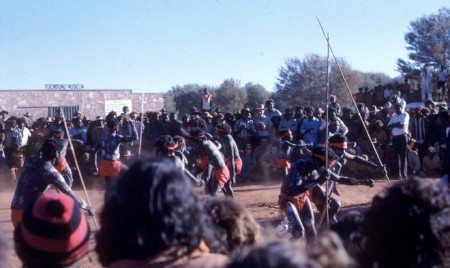
The Warlpiri moment of 1971: dignitaries at the official opening of the Yuendumu Men’s Museum on 31 July. This and other historic photographs below supplied by Warlukurlangu Artists.
By KIERAN FINNANE
Early in September at Yuendumu – the community on Warlpiri lands some 300 kms north-west of Alice – a new chapter on the beginnings of the contemporary Western Desert art movement will be written.
Reclaimed from obscurity, the Yuendumu Men’s Museum will once again open its doors. Inside, a priceless treasure of cultural heritage, murals created by the community’s Old Men in the weeks, possibly months ahead of 31 July 1971. That was the date of the museum’s official opening, attended by dignitaries including Harry Giese, Director of Welfare in the NT Administration and member of the NT Legislative Council.
The murals represent key Dreaming stories of the different Warlpiri ‘skin groups’, imagery from the sacred caves across their lands that with white settlement had become increasingly hard to access.
 “Instead of Old Men taking their young fellas out there and showing them the paintings and the stories associated with that particular place, they decided to build a museum,” says Harry Jakamarra Nelson, speaking together with Thomas Jangala Rice to the Alice Springs News Online.
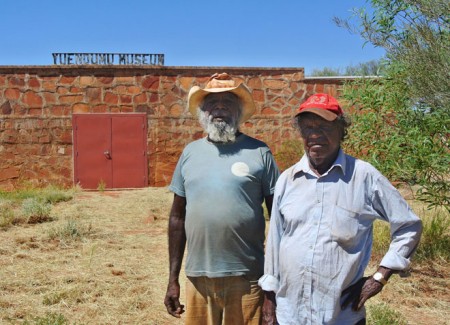
The two (pictured below right) were young men at the time of the opening, and had camped close by the museum in the two weeks prior – “to give the old fellas a hand, transport, firewood,” says Jakamarra. On the day, Jangala joined his elders in the dancing – “a proper cultural regatta”, says Jakamarra. He didn’t dance: “I was MC, master of ceremonies.” He laughs, twisting his hand at his throat and making a strangulated noise: “I was in a suit.”
Jangala draws in the sand, showing parallel lines converging in four directions towards a central square. He speaks in Warlpiri to Jakamarra who translates: “What Thomas is saying, people from the east, north, south and west all came together here and talked a lot about establishing the museum. Long before the museum was built they talked about it quite a lot. Proper consultation, the different groups, the different moieties, you might use that term in some white man’s language.”
 The date of the opening makes clear that the painting of the murals had begun at the same time, possibly even before the famous Honey Ant murals on the external walls of the school at Papunya, the event celebrated as the founding moment of the contemporary Western Desert art movement. Geoffrey Bardon, the school teacher who famously encouraged their creation, documented their progress over the months of June to August 1971. At Yuendumu the work was complete by 31 July.
It’s not a matter of challenging the place of honour accorded to what happened at Papunya, rather a case of recognising that something of profound cultural import was happening at Yuendumu at the same time, making the foundation story of contemporary Western Desert art richer and deeper. And our great good fortune is that the Yuendumu murals remain intact, while those at Papunya sadly, almost unforgivably, were painted over at the order of some unthinking bureaucrat.
The undertaking in the two communities was of a different nature, however. At Papunya the murals were for public viewing, whereas at Yuendumu, with no non-Aboriginal involvement, they were secret-sacred, and access to the museum was then highly restricted. Not only were sacred cave paintings reproduced, but sacred objects too were transferred to the museum, most of them kept locked away in cabinets to be shown only to the right people during ceremony. The layout of the museum oriented the murals and the cabinets with their precious contents to the country from whence they came.
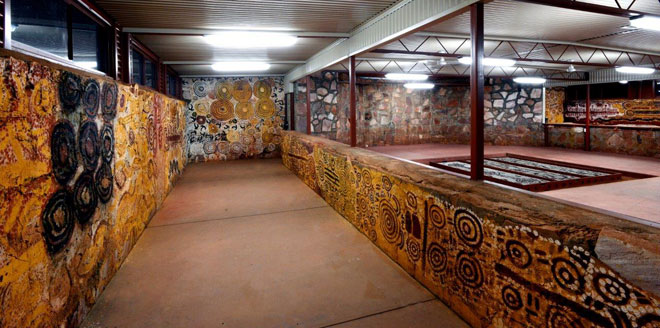
Inside the restored museum. Photograph by Greg Weight, courtesy Warlukurlangu Artists.
“For a brief period, it was the most coherent museum presentation of Aboriginal culture in existence, and no museum today could emulate it,” says Philip Jones, historian and curator at the South Australian Museum (SAM). Following on from his account of the Yuendumu Doors, which are now in safekeeping at the SAM, Jones has written a book about the Men’s Museum, to be launched at its re-opening in the community on September 6.
The murals are “unique in the canon of Australian art”, says Jones. “Aboriginal artists took the opportunity on their own terms, in their own space and time, with no white person looking over their shoulder, to produce a coherent set of paintings reflecting the art of their country.”
How can such a significant historical event have been forgotten for so long?
Although its secret-sacred contents restricted access, from the start the Old Men had the idea of the museum also being a showcase for their culture. Non-Aboriginal men and even older non-Aboriginal women were allowed entry on payment of a fee.  The late Darby Jampijinpa Ross (pictured at left) had been employed by the SAM in the 1960s in a curatorial role, advising on its collection of Warlpiri artefacts. He had painted one of the murals in the Yuendumu museum and became its curator.
Jampijinpa was already in his mid-seventies, however. Jones suggests that to keep the museum open two to three younger men would have been needed as well as a steady stream of visitors. As Jampijinpa grew more frail, security was breached. Once the other Old Men became aware that their objects were no longer safe, they removed them. They took them back out to country, says Jakamarra, or to safekeeping in places around Yuendumu, to be retrieved only for ceremony. Soon the building fell into disrepair, the electricity was cut off, and the murals remained in darkness. Jones visited the building in the late 1980s and was completely unaware of them.
There was also a hiatus between the creation of the museum and the development in Yuendumu of painting on canvas to send to market. At Papunya it was possibly the very insecurity of their murals that contributed to the flourishing of painting on small boards, then canvas that was soon to so thrill the outside world. In Yuendumu the Old Men did not set up their artists’ association, Warlukurlangu, until 1985. The year before, they had painted the doors at the Yuendumu school: this too, suggests Jones, served to keep the astonishing fact of the murals in the shadows.

The newly commissioned ground painting, representing Honey Ant, Desert Possum and Water Dreamings belonging to the eight Warlpiri skin groups. Photograph by Greg Weight, courtesy Warlukurlangu Artists.
Fast forward to late 2006. Warlukurlangu Artists had become the largest Aboriginal art centre in the desert, with some 400 artists on its books, and turnover from art sales had reached $1.5m (the next year it jumped to more than $2m). Artists had been contributing some of their profits to infrastructure developments within the community, capably overseen by the centre’s manager and assistant manager, Cecilia Alfonso and Gloria Morales. At a board meeting in October there was discussion about future projects. Reopening the Men’s Museum won the board’s support. Alfonso and Morales took it on with gusto, obtaining substantial funds for renovation of the building and restoration of the murals. They employed Catherine Millikan of the National Gallery of Victoria to undertake the conservation, meticulously following the Burra Charter process.
As the project neared completion a three-panelled ground painting (above) was commissioned for the building’s central space. The ground painting made back in 1971 on the then dirt floor had long since vanished. The new work uses the traditional technique of motifs rendered in plant fibre and natural ochres. Jakamarra explains that “Old People” made it: “This is shared, not for personal use, used by groups.” It represents Yurrampi (Honey Ant), Janganpa (Desert Possum) and Ngapa (Water) Dreamings, each associated with sites in and around Yuendumu and belonging to, respectively, Japanangka and Japangardi sub-sections (or ‘skin groups’); Japaljarri and Jungurrayi; and, Jampijinpa, Jangala, Jakamarra, and Jupurrula.
The building itself – for which the Warlpiri raised half the funds and on which they laboured – is simple yet beautifully proportioned, with the aura of a place of worship. Its basic fabric has stood the test of time well. The roof has been replaced and some modifications made to allow daylight in. Never again will the murals languish in darkness.
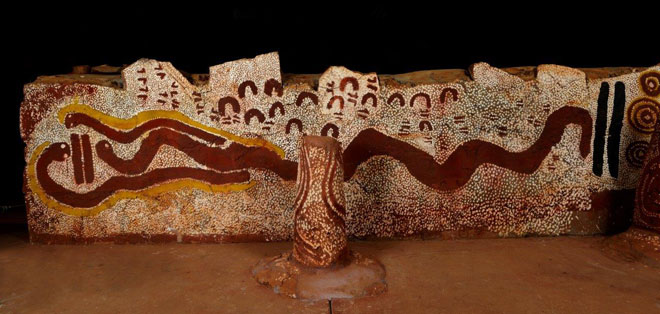
Snake Dreaming mural, and the painted termite mound in front. Photograph by Greg Weight, courtesy Warlukurlangu Artists.
Light now streams in from a recessed skylight, falling on the local red stone of the winged rear wall, radiating a warm glow into the central space. The murals, in natural pigments, are on the walls to either side, rising from the floor to a row of high windows, and covering the low walls that separate the side-aisles from the central space. Standing in one of the aisles, painted termite mounds have also amazingly survived. “They have meanings too, these mounds, ant beds,” says Jakamarra but he leaves it at that.
More than four decades have passed since the museum was first opened. While much of Warlpiri life has endured, much has also changed. As the project to restore the museum got underway, the Old Men formed a committee to oversee it and agreed that former restrictions on entry should be lifted.
For the celebration on September 6, also marking the thirtieth anniversary of Warlukurlangu Artists, people from all over Australia have been invited.
“White people will stand at the side,” Jakamarra says, “watch the ceremony going on. They, white people who live here, are part of us as well, they can take part, not in the actual ceremonies, but in the occasion.”
What about going inside?
“We will be going inside, yeah. All they’ll see is just the murals on the wall, ground paintings, similar to the ones they see once a year when we perform young men’s ceremony. Cannot be talked about or photographs taken.”
An experience to live, and after decades of forgetting, to remember.

Above: Painted up for the “proper cultural regatta”, Warlpiri men arriving at the museum on 31 July 1971.
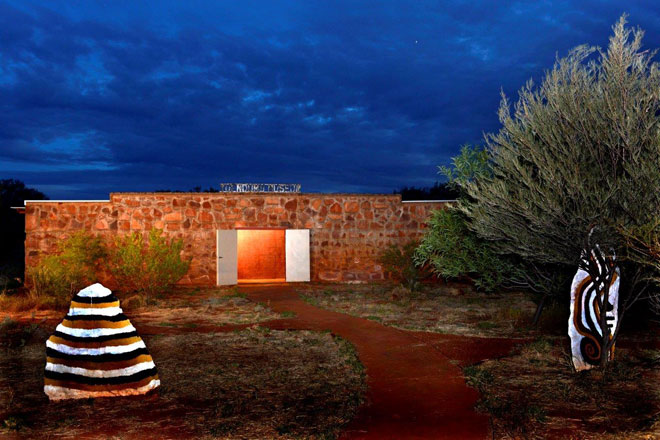
Below: The restored museum at dusk. Photograph by Greg Weight, courtesy Warlukurlangu Artists.
Note: Kieran Finnane has contributed an essay on the museum to Sturgeon magazine, published by Artbank and due out in late August.
Inspirational!
I had the privilege of being shown around the Men’s Museum when I lived there in the seventies. And I was shown ceremonies and some sacred sites in the area as well. In those days the required secrecy was maintained but there was always a great openness, a willingness to share in a dignified way. The old Warlpiri I knew were keen to educate us kardiya, to try to somehow make us understand their notion of sacredness and its expression. They have always tried to maintain a balance between the secrecy on which sacredness depends and the public expression of a people’s collective soul. It is a truly wonderful thing that the Men’s Museum has been renovated and will be open to the public. Beneficial adaptation to new circumstances is not only possible but is being done. The people of Yuendumu and the hard working staff of Warlukurlangu Art Centre should be heartily congratulated.
Interesting story but…
In the 1970s there was mainstream interest in preserving and showcasing Western Desert culture and it was this interest that drove both the art movement at Papunya and in an ephemeral way at Yuendumu.
At Papunya, Geoffrey Bardon shaped his artists to produce art for a newly emerging market.
The artists were not self consciously engaged in cultural renaissance, they simply wanted money to access the goods of the society they lived on the fringes of. Ian Dunlop’s video of the interaction between Pintupi/Luritja people and Bardon in the early ’70s illustrates this nicely.
Painting at Papunya had nothing to do with insecurity of their murals, it had everything to do with having Bardon on hand and a market for their work and being paid.
That wasn’t on offer at Yuendumu at that time except for the one off museum project.
The lavishly constructed men’s museum was funded by government to address some of the sins of assimilation, to restore Aboriginal pride, in a changing political landscape.
But Aboriginal people had changed and there wasn’t much interest in protecting sacred items in the museum so these were neglected or returned to country to rot away, as is the custom.
There was no direct connection between the museum and painting for the market at the time and it was much later that the art movement took off in Yuendumu.
Even when it did start up Warlpiri men had little to do with it and women were mostly the artists.
So the museum doesn’t really connect with the Western Desert art movement as this story suggests and there can be no legitimate claim to usurp the Pintupi/Luritja originators.
Tjapangati, a few points:
• An artist wanting a monetary return on his or her work does not negate cultural reasons for doing that work, nor the work’s life in the culture independent of the artist’s intention.
• Your suggestion that there is no connection between the museum and the later painting movement ignores the visual evidence – the continuity in the iconography – and the historical evidence – some of the same artists going on to be involved in the painting of the school doors in 1984 and the founding of Warlukurlangu Artists in 1985,among them P. Japaljarri Stewart and P. Japaljarri Sims.
• I specifically make the point that recognition of what was happening at Yuendumu is not about ‘usurping’ the place of what happened at Papunya.
• The point about the insecurity of the murals at Papunya is suggested as a possibility. I should have sourced it anyway to Philip Jones. In his book Behind the Doors, he writes: “Without a secure and private space, the Pintubi artists had little alternative but to place their designs onto temporary and transient surfaces. Encouraged in this by Geoffrey Bardon, their art soon became both marketable and market-sensitive … The situation at Yuendumu offers a great contrast, for almost at the same time, the Warlpiri’s first efforts at mural painting were made securely and privately, on the internal walls of their own newly built museum.”
Tjapangati, On the question of the government’s ‘lavish’ construction of the museum, the following is interesting. An article published in the 1972 edition of the Journal of the Royal Historical Society in Queensland sources its information, or perhaps reprints an article from Northern Territory Affairs, a periodical published by the Federal Government’s then Department of the Interior. A digital copy of the RHSQ article is available online.
The article reports the museum cost $14,000, of which $7000 came from the Aboriginal Trust Fund (a fund receiving mining royalties from operations on Aboriginal reserves, this being in the days prior to Land Rights). According to the article, “The remaining $7000 was raised by the Aboriginal people themselves.”
The article also reports an extension to the recreation hall in Yuendumu at a cost of $54,000, with $25,000 coming again from the ABTF, and “the remainder from the settlement’s Social Club”. In comparison, the cost of the museum appears quite modest.
@ Pamela Nathan: Yes inspirational. It is in this paragraph about the “new painting” that enables one to move out of the analytical and connect with the ancestral stories and the spirit of place that has endured, despite the ravages of the times. Helping us all to remember who we are in time and space.
As the project neared completion a three-panelled ground painting (above) was commissioned for the building’s central space.
The ground painting made back in 1971 on the then dirt floor had long since vanished.
The new work uses the traditional technique of motifs rendered in plant fibre and natural ochres.
Jakamarra explains that “Old People” made it: “This is shared, not for personal use, used by groups.”
It represents Yurrampi (Honey Ant), Janganpa (Desert Possum) and Ngapa (Water) Dreamings, each associated with sites in and around Yuendumu and belonging to, respectively, Japanangka and Japangardi sub-sections (or skin groups); Japaljarri and Jungurrayi; and, Jampijinpa, Jangala, Jakamarra, and Jupurrula.
I am always wary of whitefellas identifying themselves by skin name. It can indicate an unjustified claim to insider knowledge beyond the ken of lesser mortals. It can also be used to establish a kind of mysterious anonymity. I was given a skin name, along with everybody else working at Yuendumu at the time whether they knew it or appreciated it or not, 39 years ago. I use it with those Aboriginal people who know me because it fits me into their social universe, not because it gives me any special status. It can be used to show affection and respect but also to admonish me and remind me of what they regard as my obligations to them that I often refuse to recognize because I want to avoid bankruptcy. I don’t use it with others, who don’t know what it means, just to impress them. That often backfires. We had a joke in the old days. ‘There’s a special ward in Alice Springs Hospital where whitefellas can go for a skin change.’ There are those who change the name to suit their changing relationships with serial partners. You can’t take it all too seriously.
You are wrong about so many things Japangardi. I have a feeling you weren’t around in the seventies or you wouldn’t write such nonsense. Kieran has rightfully pointed out your more obvious errors. I was at Yuendumu on the weekend and discussed some of your comments with some of the Warlpiri residents. They were not happy and bluntly denied that the establishment of the Men’s Museum way back then had anything to do with what was happening at Papunya. Everybody I spoke to has close relatives at Papunya. Rivalry between these language groups is contrived and used politically by malcontents with an axe to grind or something to be gained from provoking unnecessary conflict.
Harry Jakamarra Nelson was at the opening of the museum, like all other dignitaries, dressed in suit and tie. His brother Michael has had a central role in the Papunya Art movement. My father-in-law, Dinny Japaljarri France, was also there similarly dressed. He was immensely proud to be involved. He was born within a stone’s throw of Pintupi country, spent a lot of time at Haast’s Bluff in his younger days and never failed to acknowledge his close kin and cultural relations to the people to the west and the south. The relationships between the communities form an unbreakable web. Even if the Yuendumu mob were trying to emulate those at Papunya this would make sense because of the close kin connections between the two communities. The Western Desert Art movement moved very quickly beyond what Bardon did and involves dozens of communities. Rivalries should be left on the football and softball fields where they belong.
I arrived at Yuendumu in 1976. The first painting I acquired was by a Papunya artist, some works from Papunya were being sold at the ’76 sports weekend. The next several art works I acquired in that year and soon after were all by Warlpiri men who were painting boards and artifacts for sale regularly. Men were in it from the start and still are. There is nothing ‘ephemeral’ about the Warlpiri art movement. As for the funding of the museum to compensate for the ‘sins of Assimilation’ I can tell you that many of the expatriate staff at the time were unreconstructed assimilationists, several were, what we called, ex-PNG mafia. A change of policy at the top doesn’t imply a change of heart at all levels. I don’t trust the post modernist critic who looks down on us from above with a God like eye knowing our motivations better than we know them ourselves. Japangardi not only knows the motives of the funders better than they did themselves but also the motives of the artists at Papunya. Forget cultural renaissance, it was all about the Almighty Dollar.
As far as I could see then and from my continuous contact with the Yuendumu community since, Warlpiri and Pintupi/Luritja men and women have produced art for the same reasons that anybody else, in any culture, does, it’s an intensely enjoyable activity, it’s seen as preserving or highlighting at least some elements of culture valued by the artist and a living can sometimes be made from it. Whoever is giving Japangardi insider advice on what goes on at Papunya has a jaundiced and cynical view of humanity. The bane of Aboriginal politics is jealousy. Rather than praise or encourage the productive efforts of others there are always those who will try to bring them down and denigrate their achievements. If you have anything to do with the Aboriginal art industry you’ll notice that this attitude soon infects some of the non-Aboriginal operators as well. Or maybe they were already like that and didn’t need to be infected. Kieran’s article has not tried to do that in relation to the art movement at Papunya. Why is Japangardi trying to do that in relation to the art movement and museum at Yuendumu?
I visited the Men’s Museum in 89-90 or thereabouts. Old Pat Forster and I did a bush trip. It was an eye-opener for Pat. Dinny Nolan was our host at the Museum and very proud to take us into the room with the ground painting. I’d forgotten about this special trip that Pat and I did until I read Kieran’s article. For those who knew Pat Forster but had no idea how he ended up living in Alice Springs, his wife had passed away and I suggested he come up to Alice for a break. We went out bush, including to Yuendumu and Papunya, and Pat fell in love with the colour and landscape. I got a call from Pat as soon as he’d landed back at Melbourne Airport (hadn’t even collected his bags) and he said he’d decided to sell up and move to the Alice. Now, as we know, his ashes rest under a tree at Olive Pink Reserve. Thanks for a great story Kieran and let’s try not to deconstruct the story or the intent behind the establishment of the Museum but just enjoy its revitalisation and the stories it evokes.
Yuendumu community is on Anmatyerre country, not Warlpiri.