
Buffel plan: Local knowledge or bureaucrats picnic?
An online national meeting tomorrow afternoon will be an opportunity for taking a critical look at Buffel Bulldozer, a report by the Arid Lands Environment Centre (ALEC) in Alice Springs about the devastating weed taking over much of The Centre.
The organisation wants action Australia-wide.
At present buffel is declared a weed under legislation with funding in South Australia (2015) and the Northern Territory (2024).
It is acknowledged as a threat to nature but not yet a declared a weed in New South Wales (1995), Western Australia (2007), Australian Government (2014) and Victoria (2015) – a time table illustrating the extended official inaction.
Queensland has no position, “resistant to buffel grass action due to its value as a pasture grass,” states the report.
“It is not all a positive story though, the Country-Liberal Party Northern Territory Government has allowed pastoralists to continue to spread buffel grass in the Territory, making the problem worse.”
This is despite "buffel has no boundaries," as the report states.
It is long on describing the devastation as the weed displaces native flora but all this is well know. The Alice Springs News, for example, has reported about the catastrophe for much of its three decades in publication.
Buffel Bulldozer emphasises the role of governments in the war against the weed, which may turn the campaign into a bureaucrats picnic.
This is how government agencies got it wrong: “The Commonwealth Scientific and Industrial Research Organisation (CSIRO), government departments, pastoralists and soil scientists played a role in the landscape scale introductions of buffel grass by planting it for pasture grass trials and dust suppression.
“For example, the Northern Territory government planted buffel grass around Alice Springs airport to control dust storms – a short term solution with long term consequences for nature and public safety.”
The report gives examples of efforts by NGOs, such as Marlinga Tjarutja Land Management Team, and individuals, including the New Eastside’s legendary Valmai: “Over the years, spending about one hour per day, Valmai has controlled buffel grass in an area of around 5ha.
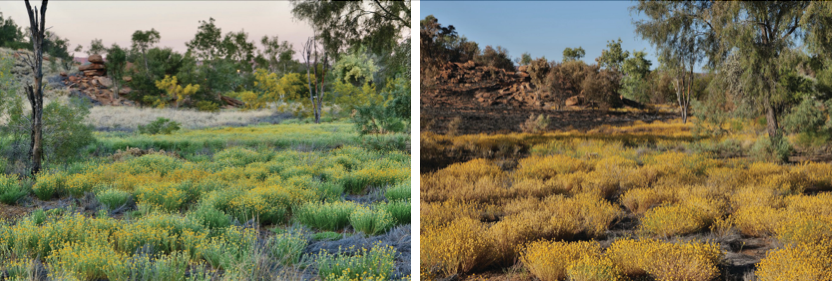
“Native herbs and grasses dominate the ground layer. Winter rain now brings on a flush of wildflowers in stark contrast to the drab monoculture of buffel.”
However, given the immense extent of the problem, it is clear that massive volunteer as well as unconventional manpower (there are more than 600 people in the local prison) would need to be deployed in a carefully structured way, using the ample local knowledge: When, how and where should spraying and other control measures be deployed?
The report presents no details of such organisation.
Meanwhile it recommends “a national buffel grass coordinator who would act as a key contact point nationally [supporting a] taskforce which would have broad membership across jurisdictions and sectors [developing] a National Buffel Grass Strategic Plan.
“We call on the Australian government to list buffel grass as a stand alone Key Threatening Process and develop an adequately funded Threat Abatement Plan.”
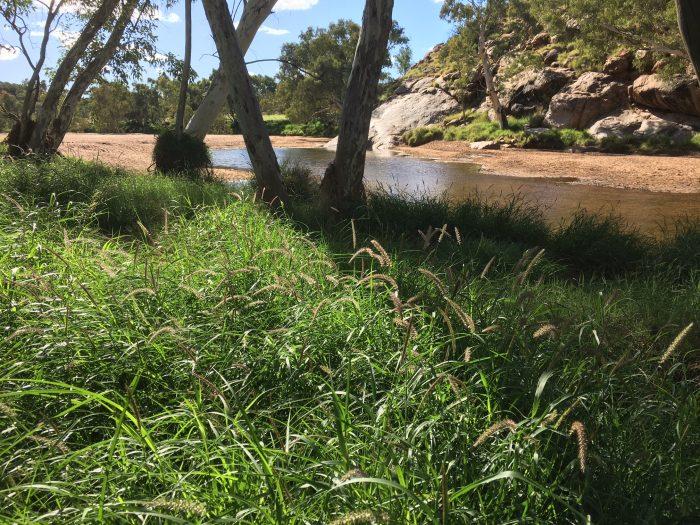
PHOTOS Fiona Walsh: Kurrajong Landcare site, before and after buffel grass fire. The sites where buffel had been removed did not burn.
Comments
No comments yet. Start the conversation.