
Builders battling for bush jobs
Aboriginal Enterprises Australia NT going into administration has again put under the spotlight issues of housing in remote areas and the spending of public money.

Aboriginal Enterprises Australia NT (AEA) going into administration has again put under the spotlight issues of housing in remote areas and the spending of public money.
The Aboriginal owned construction and training company is a Pty Ltd company and as such is not listed by ORIC, the Office of the Registrar of Indigenous Corporations, which publishes extensive details of organisations on its books.
All we could find out from NT Labor Senator Malarndirri McCarthy about public money paid to AEA was this: “Aboriginal Enterprises Australia's current funding arrangement with the National Indigenous Australians Agency is an Aboriginals Benefit Account grant for the Swan Yard New Outstation project.
"The NIAA is working with the appointed administrators in relation to this arrangement.”
From Grant Connect we learned that this project, apparently in the Katherine region, is worth $456,417.
The Senator would not disclose any other past contract sums paid to AEA nor whether any projects are incomplete.
We would have liked to ask her: Did AEA get support grants from the Federal Government? If so, how much?
Who owns the company? The Senator was not available for an interview.
AEA has offices in Darwin, Alice Springs, Katherine, West Perth, Tom Price and Pinelands but the firm is all but unknown in Central Australia.
The Alice Springs News spoke with five builders in Alice Springs, most with decades active in the region. None of them had even heard of AEA.
Master Builders CEO in Darwin, Sallyann Innes, says she had briefly spoken with AEA CEO Steven Dhu but she is not familiar with details of the firm.
Its website isn’t much help, either: “Construction, Maintenance, Nationally Accredited Training, and we are only just getting started” it announces.
“We are creating sustainable economic opportunities with a positive impact for Aboriginal people and their communities. We provide a range of construction and maintenance services which keep communities operational and progressing forward.”
Two companies in The Centre have created a form of partnership – sometimes called black cladding – with Aboriginal interests which gives them the front running in getting “Aboriginal” work from the government, according to industry sources in Alice Springs.
McMahon Services in Alice Springs has established Intract Australia Pty Ltd. It is reported as 51% Indigenous-owned, managed and controlled, providing “civil construction, building works, maintenance and remediation” with the purpose of “providing Aboriginal and Torres Strait Islander people with employment, training and career opportunities,” according to ChatGPT. (The News has emailed Intract several question.)
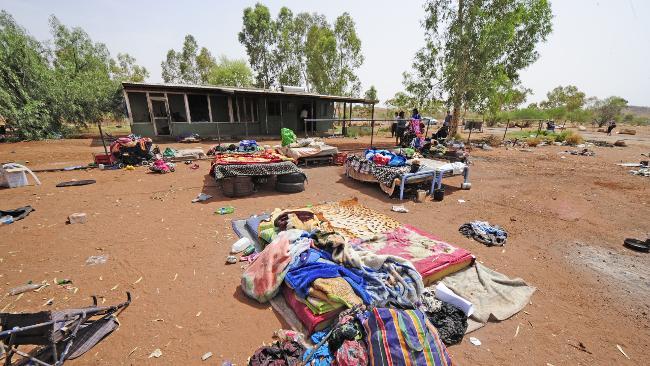
The photo at top is from Intract’s website yesterday which has been taken down and replaced with “new website coming soon”.
The local firm Asbuild has joined with Centrecorp to form Centrebuild.
Its website describes Centrecorp as aiming for Aboriginal economic development and participation in the NT “resource and tourist development boom”.
It was incorporated in 1985 with $1500 and is now trustee for over $200m worth of investments around the nation “that are used to support funding to Aboriginal people of Central Australia.
“The majority of Centrecorp’s investments are 50/50 business partnerships [with] businesses which have the necessary industry specific expertise and skills.”
The main source of money for Centrecorp clearly originates from the massive royalties the gold miner Newmont north-west of Alice Springs is required to pay to traditional owners and the Central Land Council (CLC) under the land rights legislation.
Centrecorp shareholders are Central Land Council (3 shares), Central Australian Aboriginal Congress (2 shares) and Tangentyere Council (2 shares).
That of course means that Congress and Tangentyere together can out-vote the CLC.
It is understood that owning shares does not mean the organisations can personally take profits from Centrecorp because the charitable trust deeds restrict shareholders from receiving benefits from the trusts.
Asbuild director Paul Graham was not available to speak with the News.
AEA’s unsecured creditors are owed “approximately $11.67m” according to the administrator, WA Insolvency Solutions (WAIS).
The list of categorised creditor amounts (total just over $1m) is headed by Community, Indigenous & Government Organisations (33%) and goes down to 0.5% for fuel, gas and industrial supplies.
Big amounts are electrical, energy and utilities (24%) and vehicle fleet, automotive and mechanical (11%).
According to a WAIS media release more than 85 jobs had been preserved, “100 cents in the dollar on more than $1.87m is being paid in employee entitlements”. Distributions to unsecured creditors are expected to be about $1.48m.
“Essential housing, power, water and infrastructure services [were] maintained in remote Northern Territory communities,” says the release.
Meanwhile AEA has received NT government work and grant funding, according to ChatGPT.
• The NT Department of Housing, Local Government and Community Development's 2024–25 annual report lists a grant of $10,173 to the company.
• Housing and Community Development funds were paid.
• Government records list contracts for housing sanitation and fire-safety works, including $1.5m and $1.38m projects completed in 2024.
• Power and Water Corporation contract: An NT government tender record lists the company as receiving a $550,000 award in a contract with an estimated value of $14.08m.
We have asked Treasurer Bill Yan to corroborate these claims.
UPDATE November 12, 2026, 6:50am
Intract CEO Luke Taylor, when asked by the Alice Springs News, said that McMahon Services holds 49% of Intract shares. He would not answer any further questions.
Comments
No comments yet. Start the conversation.