
Letter from Alex Vaughan
Burgoyne's buffel weed decision condemned
LETTER TO THE EDITOR
The Arid Lands Environment Centre condemns Minister Joshua Burgoyne's catastrophic buffel grass decision that caves to industry lobbying and puts his own community at risk, by continuing to permit the sale, trade and planting of buffel grass across the Northern Territory’s pastoral leases.
Buffel grass does not recognise fence lines and artificial boundaries. It is a highly invasive weed that devastates arid environments and communities across Australia and the world.
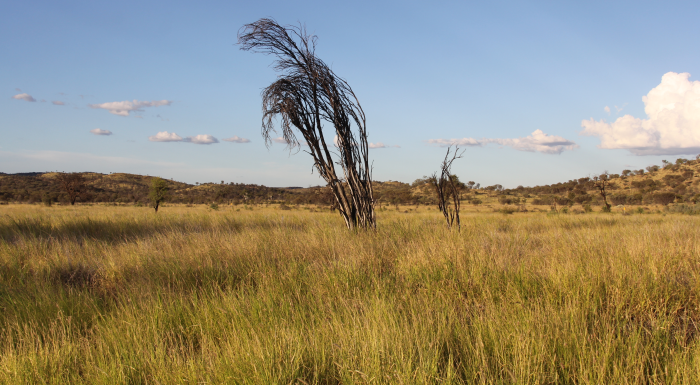
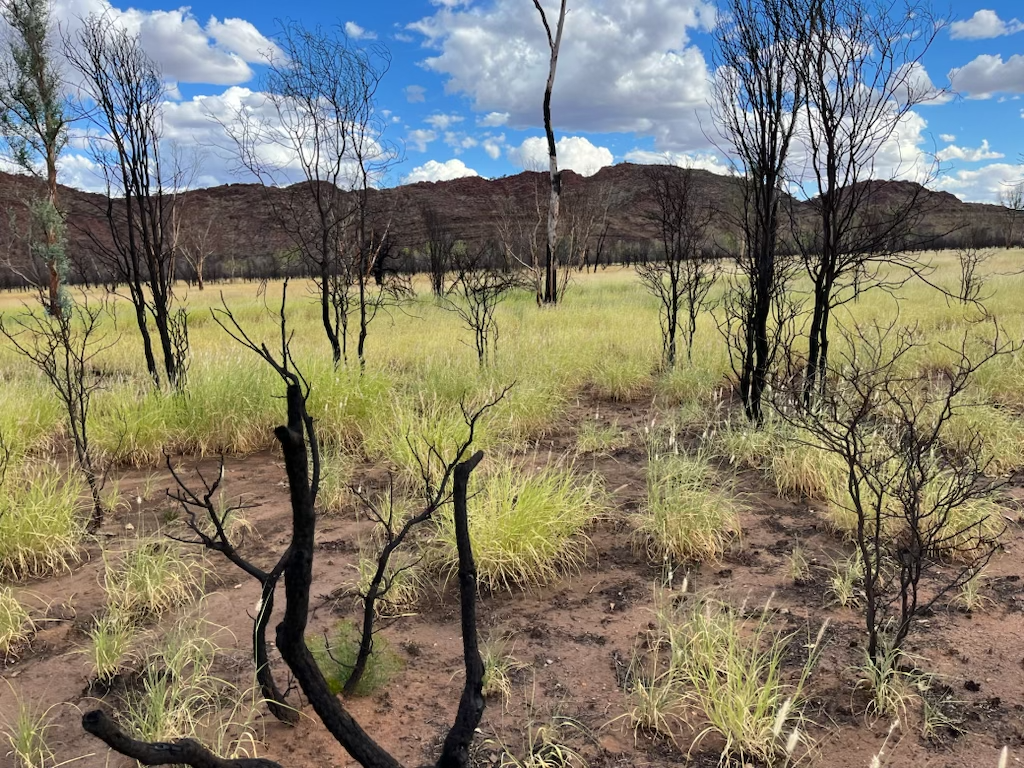
The life and colour of the arid lands is suffocating in buffel grass before it all goes up in flames.
Earlier this year, the Environment Minister stacked the Buffel Grass Weed Advisory Committee with greater pastoral representation after extensive industry lobbying, and ALEC understands he has now made a decision that ignores the majority-backed recommendation made by the Buffel Grass Weed Advisory Committee, and instead adopts the minority pastoral position.
Limiting and regulating the sale, trade and planting of seed in the NT is the bare minimum, and this is a grave backwards step on the government’s commitment to managing buffel grass as a weed.
It has been really great to see buffel grass funding and work occurring here in Central Australia since weed declaration last year, but this decision undermines this positive work that can make a real difference!
Alex Vaughan
Policy and Advocacy Coordinator, Arid Lands Environment Centre.
UPDATE 22/12/25
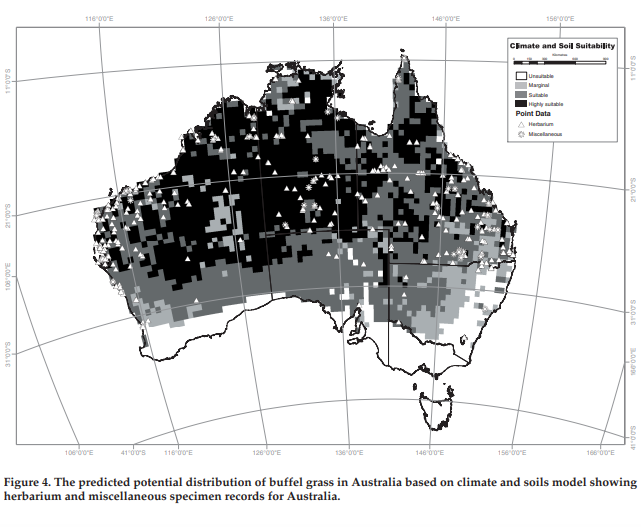
The image below shows the predicted potential distribution of buffel grass in Australia based on climate and soils model showing herbarium and miscellaneous specimen records for Australia. Image provided by Mike Gillam (see reader’s comment).

7 comments
Adrian Tomlinson
Absolutely disgraceful. Proposing a blanket permit to let pastoralists keep on spreading buffel while everyone else is being asked to manage it, is exposed to huge fire, health and commercial risks and species are going extinct. This plan simply will not work.
And then the audacity to release this draft plan for comment over Dec-Jan in what for many is meant to be a summer break. We must pushback on this draft plan.
To the Member for Braitling, the couple dozen votes you receive from this anachronistic industry which employs few and contributes about 4% GDP to the central Australian economy are not worth it. Because with every fire, every dose of asthma and hayfever, every tussock we dig up, every sacred rivergum that burns, every budget variation for fire fighting costs and the inevitable human tragedies in buffel fires, the rest of us will remember.
Mike Gillam
Marie, I'm sure it was not your intention to misinform readers on the devastating realities of buffel grass invasion across the continent. Buffel grass has already moved well beyond Alice Springs and will devastate biodiversity across most of inland Australia. I too travel widely across the inland, albeit with my eyes open. I've provided an informative map from a research paper published in 2004 so there's certainly no excuse for Minister Burgoyne to sit on his hands. This disaster is OLD NEWS!!! Our politicians should be knocking on the doors of the federal Government seeking the necessary funds and expertise to combat this grassland apocalypse.
Marie Purvis
I know buffel grass has spread further than Alice Springs, we are grateful to have it on our property. What many people do not understand is that while buffel has adapted to Australia our native animals have adapted to it. Our small animals like kultarrs, brown quails and lizards etc. actually seek out buffel habitats for feed and shelter and because the tussocks are more dense and afford them some protection from predators like feral cats. Many birds also eat the seeds and it is very pleasant to sit outbush with a cup of tea and listen to their happy chatter. I wouldn't be too concerned about your map of projected spread of buffel across Australia as it is only guesswork at this stage. We have seen the signs all over SA about the terrible invader but very little evidence of buffel further south. It seems some folk have a lot of difficulty actually differentiating between grasses, we noted this with pastoralists too. However we have observed the spread of buffel grass here since the 1970s. We don't run a lot of stock and have noticed the gradual proliferation of the native plants competing with buffel, and just like what happened with the cane toads, the buffel plants no longer grow as luxuriantly as they once did. This is a very happy landscape today. One more thing, bushfires in dense native grasses are just as devastating as buffel grass fires.
Ralph Folds
There is abundant evidence in scientific studies that invasive Buffel grass is an ecological disaster. You may want to peruse "Ranking buffel: Comparative risk and mitigation costs of key environmental and socio-cultural threats in Central Australia" in the respected journal Ecology and Evolution.
Marie Purvis
Pat on the back to Josh Burgoyne for making a considered decision about buffel grass for the benefit of the majority of the Territorians and not be swayed by the vocal and fairly misinformed minority. It's time they woke up in the real world and actually travelled around the Territory out bush. They would soon realise that buffel is only a problem here around the towns where the native grasses were grazed out years ago. Some towns people have learnt how to manage buffel on their properties and it's time the rest of them learnt from the example and put in the hard yards. We've seen the results, it can be done.
Terence Mays
At this point one wonders about your intent because EVERYTHING you have said is wrong.
Buffel grass is widely recognised by conservation scientists and government agencies as a major ecological threat to native biodiversity, not a benefit to native wildlife in any way shape or form.
Buffel grass has high biomass, rapid growth and rapid seed production, allowing it to out-compete native vegetation for light, space and nutrients, and displace diverse native plant communities.
Its dense stands dramatically increase the frequency, intensity and extent of fires compared with native habitats, leading to hotter burns that damage shrubs, trees and other native vegetation and disrupt natural fire regimes.
These changes profoundly alter habitat structure, reducing habitat quality and resources (food, shelter, nesting sites) for many native animals and facilitating declines in species diversity.
Buffel grass is a recognised threat to dozens of native species and ecological communities under Australia’s national environment law and is specifically included in some threatened species recovery plans because it contributes to habitat loss and species declines.
Experimental research confirms that native wildlife (e.g., reptiles) increase in abundance when buffel grass is removed and native vegetation regenerates, providing direct evidence that buffel invasion has been suppressing native biodiversity.
In summary, Buffel grass does not provide meaningful benefits to native wildlife in natural ecosystems and is consistently shown to be a transformative and detrimental invader — degrading habitat, simplifying ecosystems, altering fire regimes, and threatening native plants and animals across large areas of Australia.
Marie Purvis
Unfortunately your arguments are still basically hypothetical. Scientists have an hypothesis and obtain a government grant to research it and write up their "findings" when the money runs out, but how accurate are they? Money is never put aside to revisit the project after 10, 20, 30 years to see what actually transpired. For over 50 years we have observed the changes as we are rehabilitating this once over-grazed property with the aid of buffel grass. We've noted the increase of native plants, animals and birds. We would prefer to be left alone to continue what we are good at. To trust our livelihood is secure so we can continue to pay the taxes that support all you armchair experts. Hopefully one day you'll arrive in the real world and realise that farmers are a vital link in the food chain to feed Australians as more and more arable land is gobbled up under housing. Buffel grass helps us to be more productive.