


Fresh look at Flynn as Adelaide House turns 100

Adelaide House, the town’s first hospital, celebrated its centenary recently. The handsome stone building is now a museum, telling its own story, with a strong focus on its founder, the Reverend John Flynn.
EMILY HAYES, formerly the Uniting Church Minister in town, reflects on this story and work she has led in offering a richer, more honest account of Flynn and the place of Adelaide House in the history of the town and region.
This is a slightly edited version of a presentation she made at the centenary celebrations on 12 September.
I lived here in Mparntwe Alice Springs for 17 years. I was a member of this church, and later its minister, for 10 of those years.
Since February I have been living in Adelaide — which, as it turns out, is not entirely unrelated to why we are here today. Most of the funds to build this hospital came from Adelaide, and so it was named in honour of that city.
Alice Springs itself was also named after someone who came from Adelaide, Lady Alice Todd, wife of Charles Todd, superintendent of the Overland Telegraph project. But she never set foot in this place. The naming came in 1933. The town had carried the name Stuart for forty-five years before that.
But it has been known as Mparntwe for much, much longer. Of course, it is a little more complex than that because the Aboriginal boundaries don’t fit exactly the town boundaries, but Mparntwe refers to a sacred site, in what we now know as the Finke River Mission block, and an area around it. It is also the name of some of the river.
The names given by non-Aboriginal people to this country and its landmarks are recent, and they come from elsewhere. The names given by Aboriginal people are ancient. They come from the land itself, given through the Altyerre – the Creation.
I mention this because it matters to what we are doing here today.
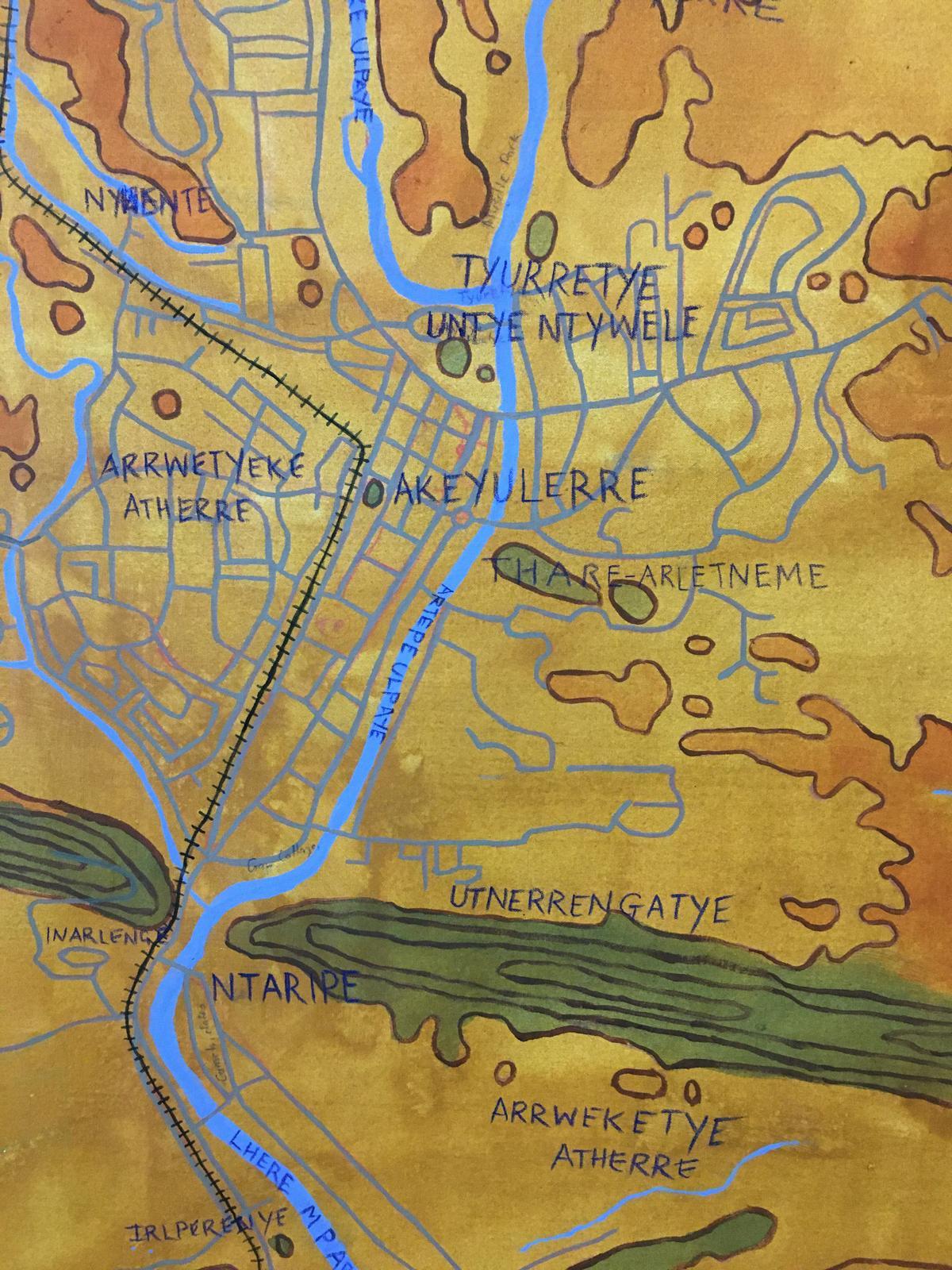
I want to talk with you about two maps that now hang in Adelaide House. These maps seek to honour the land on which Adelaide House and this town was built.
One of those maps shows some of the original names of the places in and around Mparntwe Alice Springs. The stories of these places are not always for non-Aboriginal people to know — but we can learn the names (and some are on the picture).
For me, doing so has deepened my love and respect for this beautiful land and its people and their stories. It has also made me more aware of how the less-than-a-hundred-year-old English names have slowly stifled the original ones.
But before I go too much further, I want to offer a content warning. In these reflections there will be images of Aboriginal people who have died. There is also an image that is confronting and disturbing and I will be sharing some difficult stories from the history we have been wrestling with.
I think it is important we hear these stories, but I recognise that they may be distressing for some people and it important to take care of yourself, if you need to stop reading.
These maps are the result of a project that began in 2021, in response to the ongoing national reckoning in relations between First Nations and other Australians.
Inspired by the Uluru Statement from the Heart and its call for truth-telling about our shared history, the Uniting Church was seeking ways to tell a richer, more honest account of the Adelaide House story — one that included the perspective of the Arrernte people who have been living on this land for millennia.
A number of people have been involved in this project since its beginning, and I want to acknowledge and thank them.
Three of them are sadly no longer with us — Kwementyaye Cavanagh, Kwementyaye Neale, and Kwementyaye Dolman. We miss them deeply, and we are grateful that these maps hold something of their story.

Some of the Adelaide House Museum Working Group in 2025, front row, from left: Kwementyaye Purrurle Neale, Elaine Peckham, Brenda Shields. Back row: Lisa Stefanoff, Kieran Finnane, Rev Emily Hayes, Pip McManus.
Other contributors are Mali Cavanagh, Kumalie Riley, Keith Castle, Stella Hayes, Pat Ansell-Dodds, Lorna Wilson, Kim Mahood, and Faron Peckham. I also want to acknowledge the support of this church and many others in the community, and to thank the Meeting Place Foundation for their funding.
We are a group of Arrernte and non-Arrernte people, church people and non-church people, long-term residents of Mparntwe, who began having conversations about the complex history of Adelaide House and this town, and about how we remember and talk about that history today.
How might we tell it in a way that is honest? And how might that honesty be healing?
From those conversations, two maps emerged that I am going to talk about.
First and foremost, these maps seek to acknowledge the land on which Adelaide House stands. And that this land is the land of the Arrernte people and they have an ancient and ongoing connection to it.
Some of us non-Aboriginal people also feel a deep connection to this place, but to acknowledge the particular relationship Arrernte people have with this country does not diminish that. It doesn't have to be either/or. It can be both/and.

When Adelaide House opened in 1926 as the town's first hospital, there were fewer than a hundred settlers living in Alice Springs, with others scattered across the region on missions, pastoral stations, and mining leases. These settlers were greatly outnumbered by the First Nations people of Central Australia.
And yet the hospital was not built for their care. Aboriginal people were occasionally treated by Adelaide House nurses — the very first operation performed here was the removal of a cyst from an Aboriginal man. But the Australian Inland Mission had been established in response to a report focused entirely on the needs of pioneering non-Aboriginal settlers, and the organisation remained devoted to those needs.
When it opened, Adelaide House was by far the largest building in town. It became one of fifteen hospitals across remote Australia, established through the vision of Reverend John Flynn as part of his vision to establish a mantle of safety for the Outback.
Flynn also believed in opening up the Outback and hoped the hospital would accelerate development and encourage more settlers to come — that with proper medical care, more people, especially women and children, would feel safe enough to stay.
And other developments indeed followed. The Old Courthouse and The Residency in 1928. The first purpose-built school the year after. The railway link that same year.
Growth of the town continued to accelerate in the late 1930s with electrification in 1937. Connellan Airways, the Royal Flying Doctor Service, Wallis Fogarty and Tuncks' Store — all in 1939.
These places are celebrated as part of the town's pioneering history, and rightly so.
They are also found on our second ‘living history’ map. What emerged through the process of creating it was that Aboriginal people too have connections to these buildings — stories they wanted to share.
As is always the case when we try to be honest about history, some of these stories are good and inspiring. There are stories of resilience, of fun, of tender connections across racial lines such as the story of the chemist who each week would reward all the children who attended school every day with lollies.

Photo display in Adelaide House, from left, top: Jack Ansell and daughter Patricua, ANZAC Day 1992; Edward Chong and Minnie Bell, late 1880s; Kwementyaye Neale, Wigley's Waterhole, c 1960. Middle: Lorna and Jack Ansell, 1960s; Stuart and Campbell children, Gap Cottages, 1950s; sisters Brenda Shields and Elaine Bohning, c 1953; Jack Neale, Lance Corporal, WW2. Bottom: Donald Stuart, Gap Cottages, 1950s; Jessie Neale and daughter S, c 1945; Arthur Ah Chee Snr, c 1914.
But there are also traumatic stories. Stories of grief, loss, displacement, and separation. Stories of a people's survival despite intentional and unintentional efforts to crush and silence them.
At the very same time the town was growing and the white population was expanding, this was also happening. In 1928, just two years after Adelaide House was built, the same year the courthouse and residency were constructed, there was the Coniston Massacre. Police reports recorded thirty-one Aboriginal people killed. Further investigations, Aboriginal oral history, and analyses of remains suggest the number was more likely somewhere between one hundred and three hundred.
That same year, Alice Springs was declared a prohibited area for Aboriginal people. The prohibition remained officially in place until 1965.
It seems there was no mantle of safety for Aboriginal people.
Our living history map also marks the Gap Cottages, built in the 1940s and 50s on the edge of town to provide basic housing for those who were then called "half-caste" Aboriginals. Many Arrernte people and families have complex connections to those cottages.
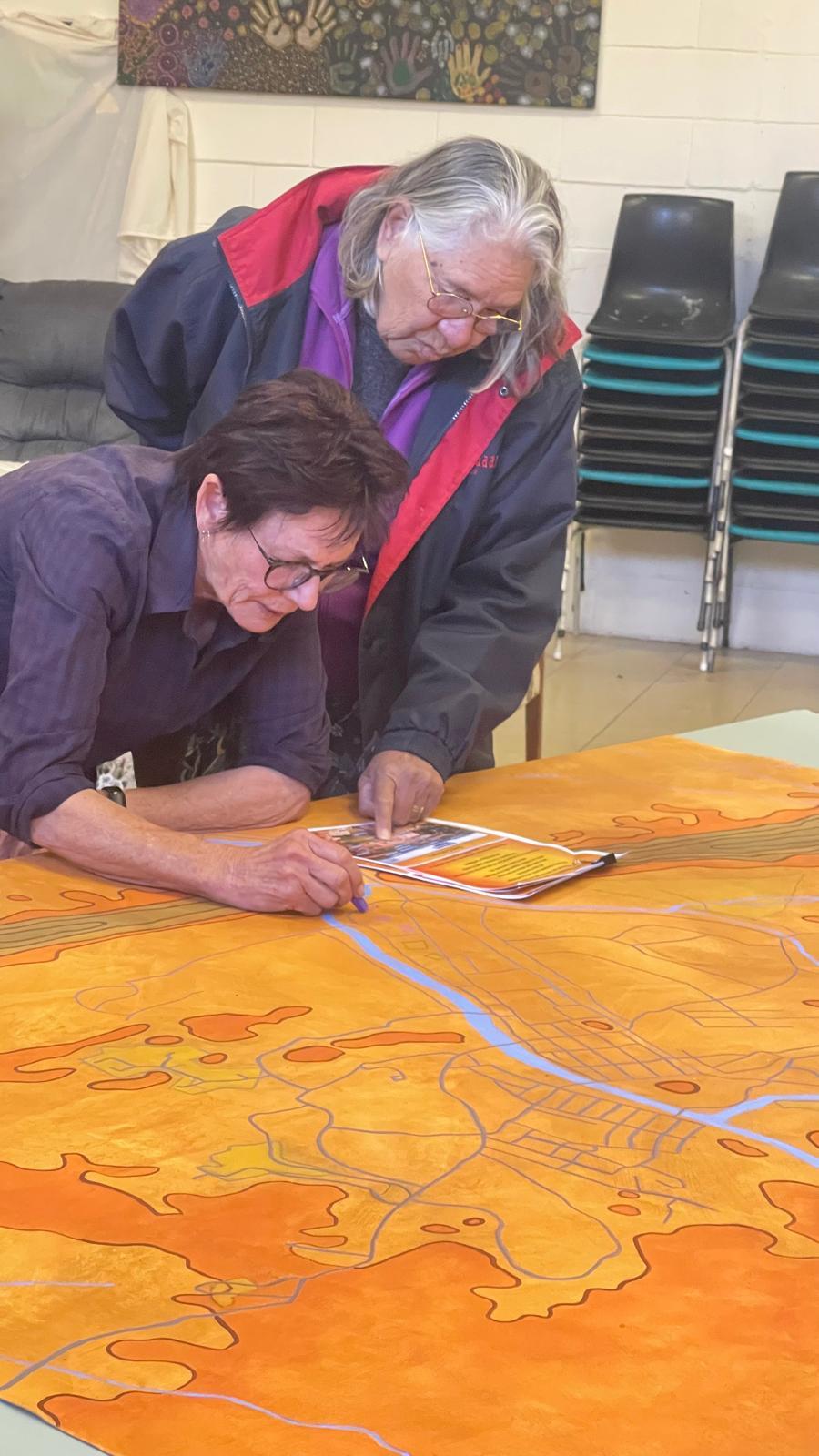
Brenda Shields with Kim Mahood.
We also marked significant Aboriginal organisations such as IAD, Congress, Tangentyere, CAAMA, that Aboriginal people established in response to the many challenges they faced. The Arrernte people who were part of our group were clear: truth-telling includes talking about the ways they have survived and thrived as well.
Across this town, and I think across this country, we tend to tell these stories separately — pioneer history in some places, Aboriginal history in others, as though they happened in different worlds. Our two maps are a small attempt to tell them together.
And we hope that, as we recognise a shared history and are courageous enough to be honest about both the great achievements and innovations in that history as well as the horrors, it can help us walk together into the future.
During these centenary celebrations we have spoken a lot about some of the great innovations of John Flynn and the work of many nurses and patrol padres who served the Australian Inland Mission. Adelaide House. Fifteen hospitals. The Royal Flying Doctor Service — which now provides twenty-four-hour medical care across eighty percent of Australia, including many Aboriginal communities. The School of the Air. Old Timers. St Philips. This church. The Institute of Aboriginal Development, founded in 1969 by Mr Lester and Reverend Jim Downing while Jim was living in Adelaide House.
These organisations remain crucial across Central Australia. Frontier Services' bush chaplains continue to support people doing it tough in rural and remote Australia, and now employ five Aboriginal bush chaplains in remote communities across Central and Northern Australia.
This is a genuine and important legacy. But it does not mean we are exempt from wrestling with what else is true.
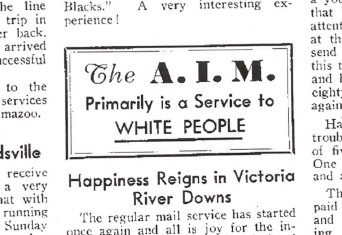
We still need to wrestle with the fact that as the excerpt from the Frontier news in 1934 so plainly states, “the AIM was primarily a service for white people.”
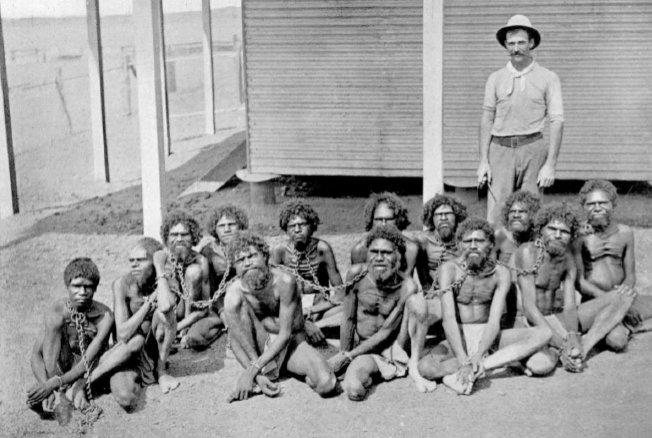
We still need to wrestle with these words, penned by John Flynn, "When we put the chains round the necks of those blacks we did a noble thing in one sense — we admitted our responsibility to lead the black man from evil practices into the things that are good and true." (See photograph at bottom, published in Flynn's The Inlander, 1914.)
Perhaps, some of you want to say to me, as many people have, that Flynn was a man of his time. And indeed he was. In this period, no Aboriginal person was permitted within the town limits unless employed there.
But even then, such views were strenuously contested by others in the church — particularly Dr Charles Duguid, who was pivotal in establishing the Ernabella Mission, now known as Pukatja. That mission was set up to provide opportunities and protection to the people of the Musgrave Ranges from disease and the predatory behaviour of some of the settlers.
But, in Duguid’s words, "there was to be no compulsion, nor imposition of our way of life on the Aborigines, nor deliberate interference with tribal custom."
Clearly, this is not a simple story.
None of our stories are.
And yet our moral reckoning with it is often strangely thin. Yes, good people can be grace amid troubled things. But the trouble remains real.
I believe that in the telling of our history we need to tell the truth about both the grace and the trouble.
And so please do visit the museum, and take some time to look at the maps, read the stories, and sit with this history. Try to resist the temptation to either idolise or cancel anyone.
Flynn wanted to help Australians hear the forgotten portions of our heritage. There is no doubt he did that well. The stories he told are now very well known.
The stories these maps tell are not.
And so, on this hundredth anniversary of Adelaide House, I would like to think he might have been pleased that the building is now being used to them.
SOON: Kieran Finnane interrogates Adelaide House photos from 100 years ago.