


Named white dignitaries, unnamed black children: who gets to be remembered?
KIERAN FINNANE, Alice Springs News co-founder and former senior writer, is one of the community volunteers on The Mapping Project at Adelaide House, outlined here by Rev Emily Hayes.
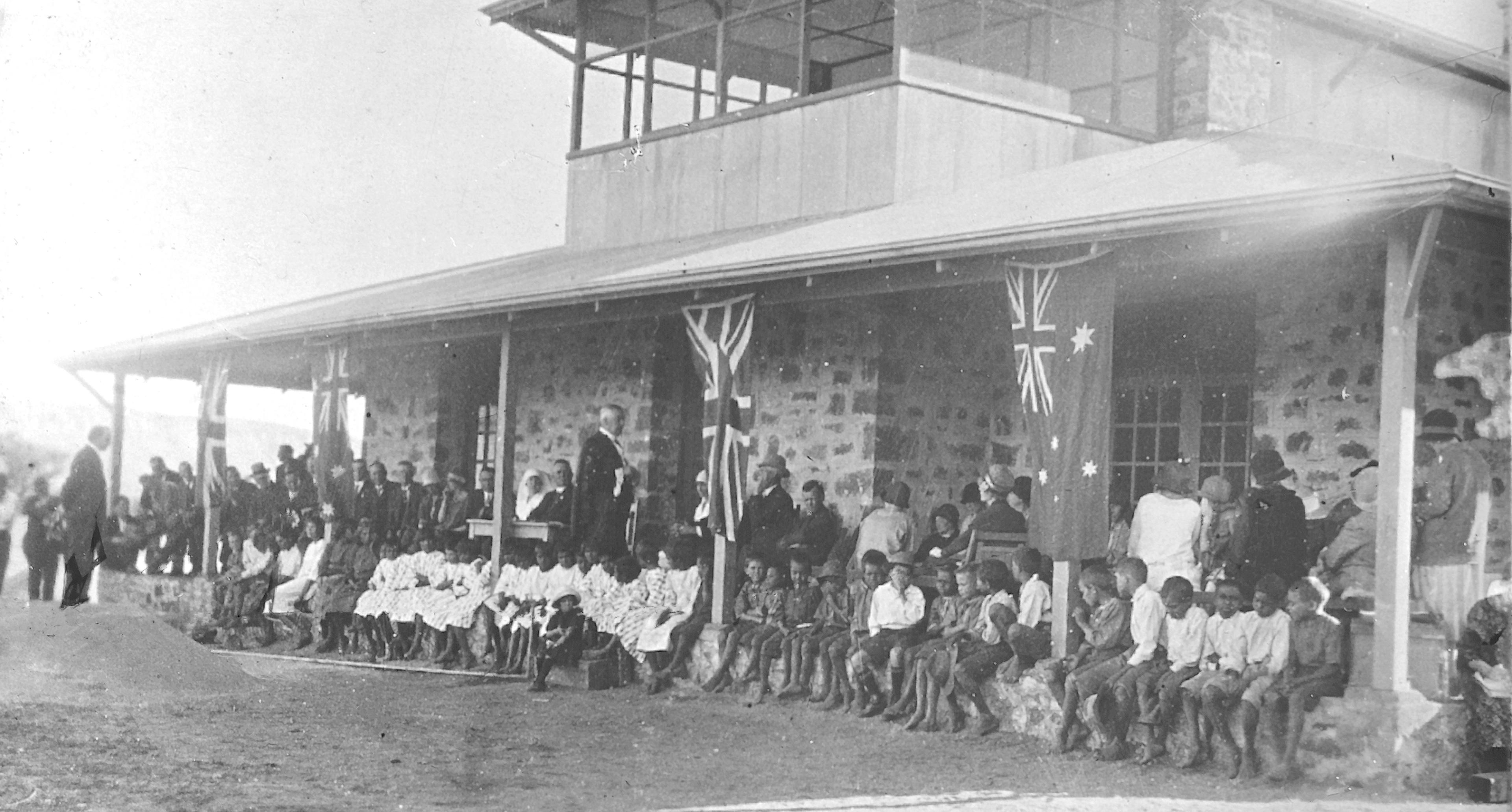
For the recent centenary anniversary celebrations, Ms Finnane took a look at aspects of Adelaide House’s opening ceremony held in June 1926, particularly as evidenced by this intriguing photo of the occasion. She approached the photo from The Mapping Project’s perspective. The following is a slightly edited version of her presentation.
Most of the work The Mapping Project has done on drawing Arrernte history into the museum has been based on oral accounts from Arrernte women who were born around the middle of the last century. They have family stories to tell that reach back further, but very little is connected directly to the work of the Uniting Church, the Australian Inland Mission (AIM), or Adelaide House itself.
This is not to say that those stories couldn’t be found, particularly from the later era of the Reverend Jim Downing – there’s potentially an endless amount of research we could embark on.
But relative to the pre-war period, this lack of connection was not all that surprising given that the AIM was designed, as Rev Hayes has pointed out and as John Flynn himself said, to serve “white people, primarily.”
“Many Aborigines are nursed by our Sisters,” he wrote in The Inlander of 1927 (one year after Adelaide House opened) “but, owing to differences in language and customs, religious endeavour on their behalf is directed by ‘Foreign’ Mission Committees.”
The 1927 issue of The Inlander came out after a silence of three years; Flynn, its editor and in this issue its main author, had been very busy. It is devoted to Central Australia, focussed on the places where the AIM was in operation.
Flynn is a good writer, he knows his subject well and clearly loved travelling inland: the landscape, the adventure, the whole atmosphere of the pioneering frontier and what he saw as its potential.
His lively, liberally illustrated account includes detailed information of how to get to the Centre, where to stay along the way, where to eat, what to expect, what to see.
The railway north of Oodnadatta was under construction at the time but wouldn’t reach Alice Springs until 1929.
On Alice Springs, then still officially Stuart, he gives a chatty overview of its history and facilities, noting “the absence of a butcher in this metropolis of cattle country.” But he mentions a saddler, a market gardener, a baker, a stock inspector and, among the many photos, shows the Stuart Arms hotel and the Wallis Fogarty general store.He also speaks of the school.
“A few white children” are being taught in the morning by Ida Standley, and over 40 “half-castes” in the afternoon. The school is still accommodated “in rather cramped quarters kindly loaned by the Police Department.” This situation has been temporary since 1915 (so ‘temporary’ for more than a decade).
There, in the cramped schoolroom, “Mrs Standley gives her full share of service,” Flynn writes. Apart from her teaching, she worked “as matron of the bungalow after school, and helping on all good works in her spare time. No wonder we all call her ‘Ma!’”
He shows a photograph of the Bungalow, where the “half-caste children” lived, it too “temporary” since 1914.
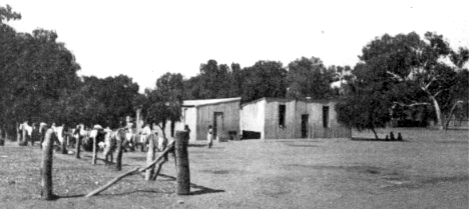
It was on the site where the first courthouse was later built, so right next door to the Stuart Arms Hotel.
We know from an official report, also dating from 1927, that this dwelling was a tin shed, with openings for a door and windows, closed by iron shutters, no glass.
The official was unimpressed: “when the doors and windows are closed no air can possibly enter the building.” The floors were of ant bed. With no verandahs, the official wrote, “the heat or the cold or the rain must beat directly onto the walls of the building.”
It was likely the same official who wrote the caption for this photo.
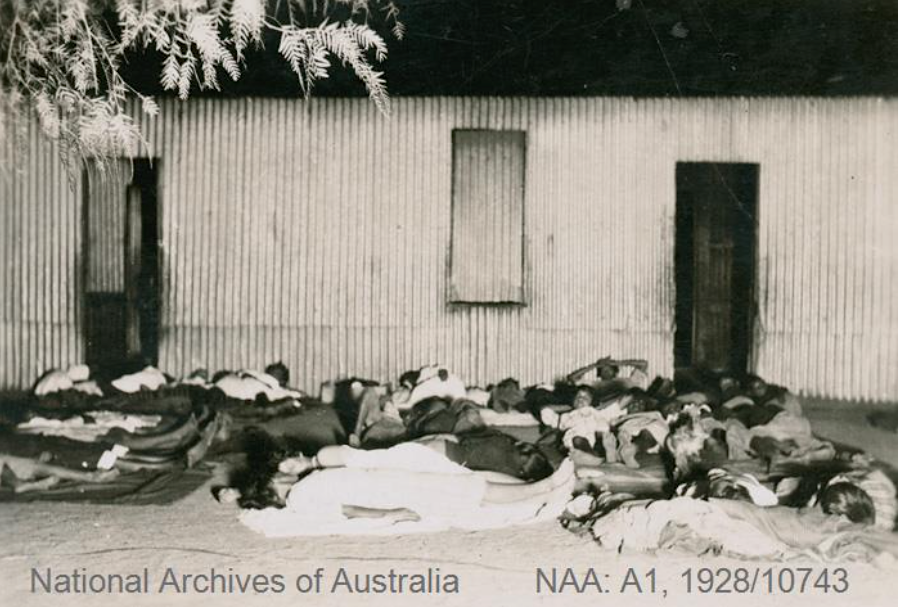
“Another flashlight view of the Alice Springs Bungalow. Their ages vary from birth to 25 years. Babies are born in the open amongst this tangled mass of half-white, half-black, humanity without any privacy whatever. The females are ‘common property’ within 30 yards of the hotel. A 10ft fence should be erected around this place without delay, and it should be locked at sundown. It is high time that they were decently housed at a safe distance”
Perhaps this was among the reports to have reached Flynn’s ears when he captions his photo of the Bungalow: It “has provoked many caustic comments, but its inmates exhibit more than ordinary happiness, and their self-discipline is beyond praise.”
Now we are getting closer to the photo (at top) that I’ve set out to interrogate.
I don’t know if there are records elsewhere of Flynn’s contact with children from the Bungalow, but that is who they are, these Aboriginal children sitting along the edge of the verandah of Adelaide House on the auspicious occasion of its opening.
Flynn writes in The Inlander of the fundraising for this first hospital for the town, about its construction and about the opening.
Some 27 AIM “enthusiasts” from Melbourne and Adelaide were in attendance.Remarkable really given the journey they would have made and the time they would have needed to make it.
Apart from members of the church, three members of the House of Representatives also came, “Messrs Nelson, Stuart and Jackson.” No doubt they would have seen Flynn’s vision for the AIM as incredibly public minded and important for their constituencies.I believe it was Jackson who took this photo, Sydney Jackson, Member for Bass in Tasmania.
The townspeople were surely all there. And we can see two veiled sisters on the verandah: they are Sisters Ellen Small and Isabella Pope, who had made an arduous journey to the Centre with Flynn. In 1927 he describes them as “quietly” enriching “The Adelaide Home.”
He doesn’t write about the children on the day even if they equalled in number, if not outnumbered the rest.
We know, though, from one of them what their connection to the occasion was.
He was Clarence Smith, youngest of the 11 children born to William Smith, a Welsh miner at Arltunga, and his wife Topsy, of Arabana and European descent. William died in early 1914, before Clarence was born.
Although William had wanted Topsy to take the children to Oodnadatta where they had family and hope for an education, Sgt Stott in Alice Springs, local Protector of Aborigines, had other ideas. He had them brought as far as Alice Springs and there they stayed.
Topsy made the journey with her living older children and a large herd of goats, while she was still pregnant. Clarence would be born in a bough shelter under a gum tree in the Todd River.
The family lived in a tent before becoming the first residents of the Bungalow, a rather grand name for the tin shed to which Topsy brought her newborn.
Soon Topsy’s children were joined at the Bungalow by others, “removed from the Aboriginals camp” in town. Topsy cared for them too, unpaid except for food and board.
She would go on to look after scores more children, right through to 1929, breastfeeding many of the babies, cooking, washing, cleaning, sewing, while Ida Standley took charge of their schooling and later became matron.
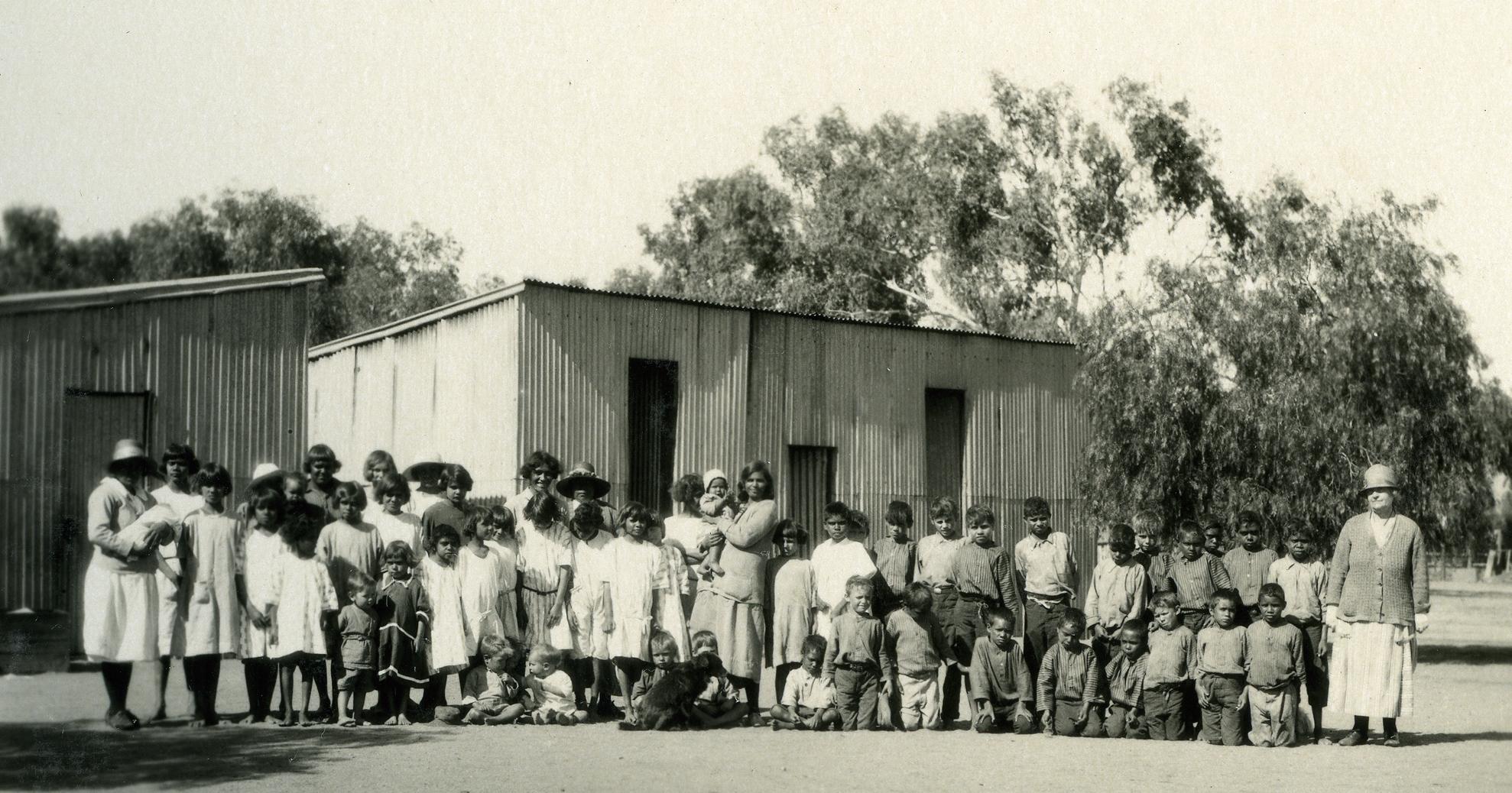
This photo was taken by a traveller in 1927. Mrs Standley is at the far right and I’m assuming that that is Mrs Smith on the far left.
If the children seemed more than ordinarily happy, as Flynn observes in The Inlander, it must have been down mainly to the efforts of these two remarkable women. There is much greater acknowledgement of Mrs Standley in the historical record, and she was paid, but it is clear that they both worked very hard for their charges in at times extraordinarily difficult conditions. They were remembered with affection and respect by many of them.
Although the AIM was not directly involved in care of the children, Sister Jean Finlayson, AIM Nurse and Deaconess, had visited the home almost daily over a period of four months in 1915. She wrote to the AIM endorsing the Bungalow’s “good work” under the supervision of Mrs Standley.
No mention of Mrs Smith.
Records also show that the AIM Patrol Padre Bruce Plowman was willing to take part in the effort to bring in some them to the Bungalow.
“Bringing in”, of course, covers a range of possible situations, including forced removal.
One of the Arrernte women we worked with, Patricia Ansell-Dodds, speaks of her grandmother and mother being forcibly removed to the Bungalow when it was later located at the Telegraph Station.
This happened at Ryan’s Well: “They were tied to a tree until the police were ready to take them to the Telegraph Station,”she told us.
From 1910 in the Northern Territory the Chief Protector had been the legal guardian of all Aboriginal children, not only those of mixed descent, and had power too over the movements of their Aboriginal parents, as did his delegate protectors, like Sgt Stott.
Topsy’s son Clarence lived at the Bungalow until the age of 12 when, like so many of the Stolen Generation boys, he was sent to work in the pastoral industry.
We are fortunate that Helen Chryssides, a dentist in Darwin and Alice Springs who worked also as a freelance journalist and writer, recorded an interview with him in 1988, in turn reported by Linda Wells in her history of the Bungalow, Living in Tin.
Reading the fascinating archival research contained in this book is how I came to learn that in the days leading up to Adelaide House’s opening celebration, the schoolroom was commandeered to serve as a dining room for visiting dignitaries.
It was a converted rations storeroom, a stone hut to which windows and a verandah had been added, next to the police station, diagonally across from the Bungalow.
“For about a fortnight” the Bungalow children were kept busy fetching firewood and stoking fires to provide the guests with hot water.
“They had big hot water containers,” Clarence recalled:
“They stood about eight to ten gallons of water in each container and they were placed in this big fireplace, and we had to light the fire about half-past five, six o’clock in the morning so they’d have hot water …
“And we had to keep this hot water system going for them – a big fireplace and wood and that, we had to cart across from the big heap the prisoners had chopped.
“There [was] no school for about a fortnight … They had to prepare it and that, a week or so before. We reckoned that was really good, you know – we were on holidays.”
He laughed at the memory.
At the time he was nearing the end of his schooldays. He hadn’t learned much there, just “spelling and so forth. Only got up to about grade three,” he told Helen Chryssides. “Well, you wouldn’t expect anything more anyhow – an hour-and-a-half a day at school.”
Clarence is likely to be one of the boys sitting on the edge of the verandah that day 100 years ago when Adelaide House was officially opened .
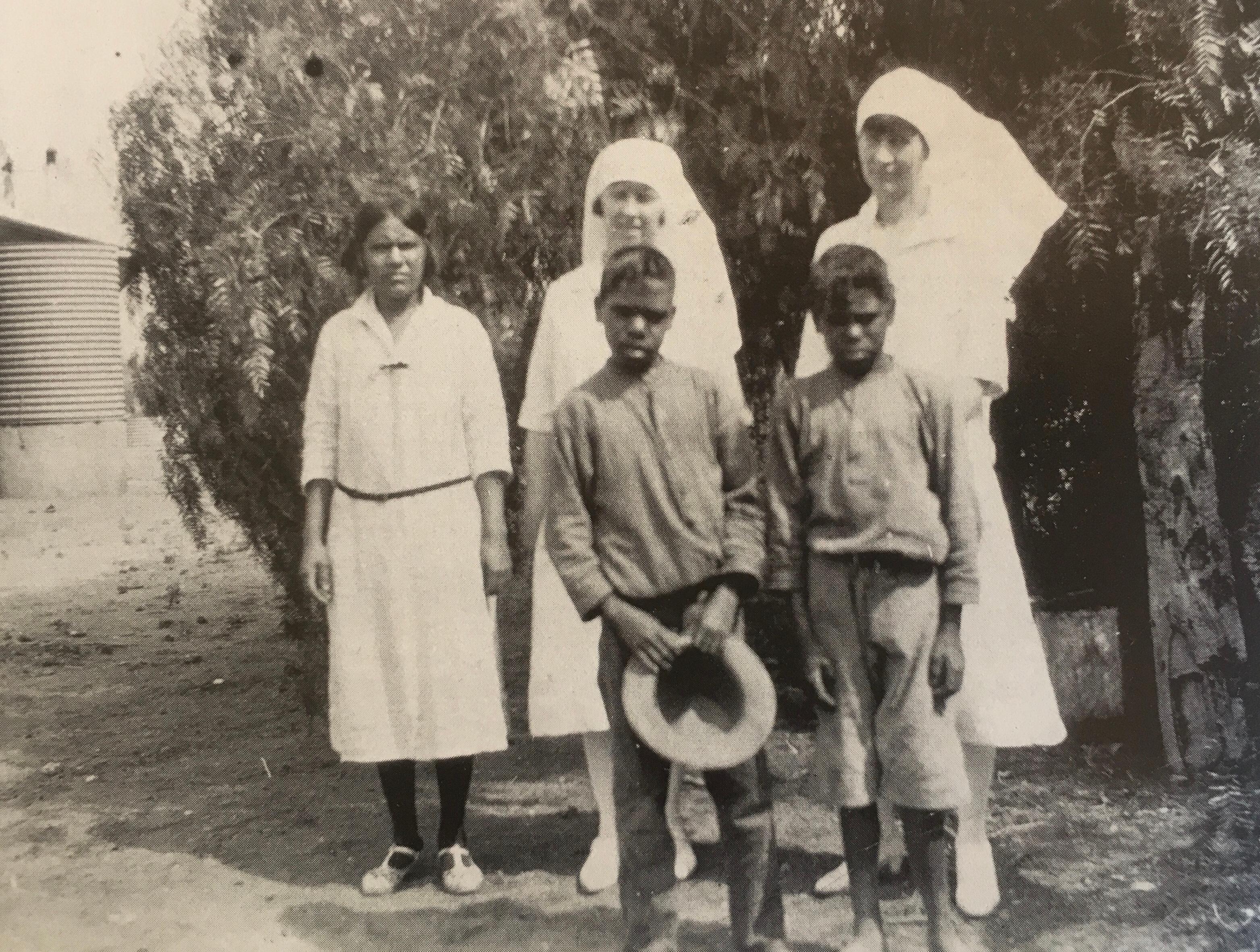
I’ve one final photo to show.
It is reproduced in Pauline Cockrill’s Healing the Heart, a history of the Alice Springs Hospital, a very interesting book on the whole.
We see five people, but only two are named: Sisters Isabella Pope and Ellen Small, the first nursing sisters at Adelaide House.
The caption does not even acknowledge the presence of the other three, for instance by saying that their names are unknown, let alone leave us any the wiser about why they are there in this moment with the Sisters.
This photo – like the photo of the opening – is part of the material heritage of Adelaide House. It half opens a window onto an aspect of its history that is mostly untold – its relationship with Arrernte and other First Nations people. Trying to push that window more fully open remains an ongoing task.
SOURCES:
The Inlander, No 19, October 1927, esp pp 2, 32, 33, 35, 43
All issues of The Inlander are archived at https://illuminate.recollect.net.au/nodes/view/4349
Linda Wells, Living in Tin: The Bungalow, Alice Springs, 1914-1929, Ginninderra Press, 2023. Esp pp 51, 74- 78, 82, 88, 90, 97, 169-70, 190, 236
Bringing them home report, pdf, pp 115-6, archived at humanrights.gov.au
Pauline Cockrill, Healing the Heart: 60 Years of Alice Springs Hospital 1939-1999, commissioned by the ASH’s 60th Anniversary Reunion organising committee, 1999.