


Nature's miracles right under our noses

By MIKE GILLAM
Some thirty years ago in Hele Crescent we focused on endemic plants that might enhance habitat restoration for urban wildlife.
The looming realities of climate change soon prompted us to cast a wider net in our choice of plants, to include northerly Tanami Desert and Sandover regions with its subtropical influence and hyper arid woodlands south of Coober Pedy.
From these regions we’ve chosen a suite of "experimental" trees and shrubs, to diversify and support our semi-arid plantings from the centre.
On a trip to the Tanami Desert I was accompanied by geographer Jorgen Doyle, plant whisperer to his friends. At Balgo the vision of seeding Grevillea refracta growing prolifically on gravelly slopes and minor drainages spurred me to voice a persistent regret.
We’d been struggling to rectify the scarcity of winter nectar in our Alice Springs gardens following deaths of the only Hakea macrocarpa (from Ti Tree) and a couple of Grevillea wickhamii (Holly Grevillea). We were lucky, seed development of the G. refracta was underway and a sprinkling of spectacular flowers raised our hopes for growing it on the colluvial frontages of Hele Crescent.
Before this latest round of nectar enhancement, our landscaping could be described as insufficient for the needs of six resident honey-eater species. A wide array of Eremophillas, several Melaleucas, a few impoverished Grevillea wickhamii, and G. striata (Beefwood) were supplemented by the sugary lerp casings of Eucalypt species and meagre quantities of nectar from various smaller flowering plants. Miscellaneous exotics from the yellow trumpets of a bushy Tecoma to pots of Aloe vera completed the nectar larder.
Competition begins early with the diminutive brown honeyeaters (at top) rushing in at first light to avoid the crowd. White plumed honeyeaters, yellow throated miners , grey-headed, singing, spiny-cheeks (when present) arrive at sunrise and bird activity can get hectic.
While all our honeyeaters are devotees of nectar and insectivorous, some have frugivorous leanings (spiney cheeked), that is, they adore the berries of ruby saltbush and the soft ripening plums of Santalum lanceolatum.
In the quest for fruit they are joined by crested pigeons, ring-neck parrots, bower birds, mistletoe birds and others. The presence of insects plummets over the cooler winter months and the competition for nectar becomes intense and critical to the survival of many birds.
The flamboyant Grevillea refracta with two tone leaves resembling polished tin has improved the viability of our gardens to support a high diversity of desert honeyeaters. Depending on rainfall this species flowers for many months and the huge green seed pods wouldn’t look out of place as Christmas decorations.
By Alice Springs standards, six species of honeyeaters is a rich community, although some disappear periodically. Imagine my surprise when a stranger arrived.
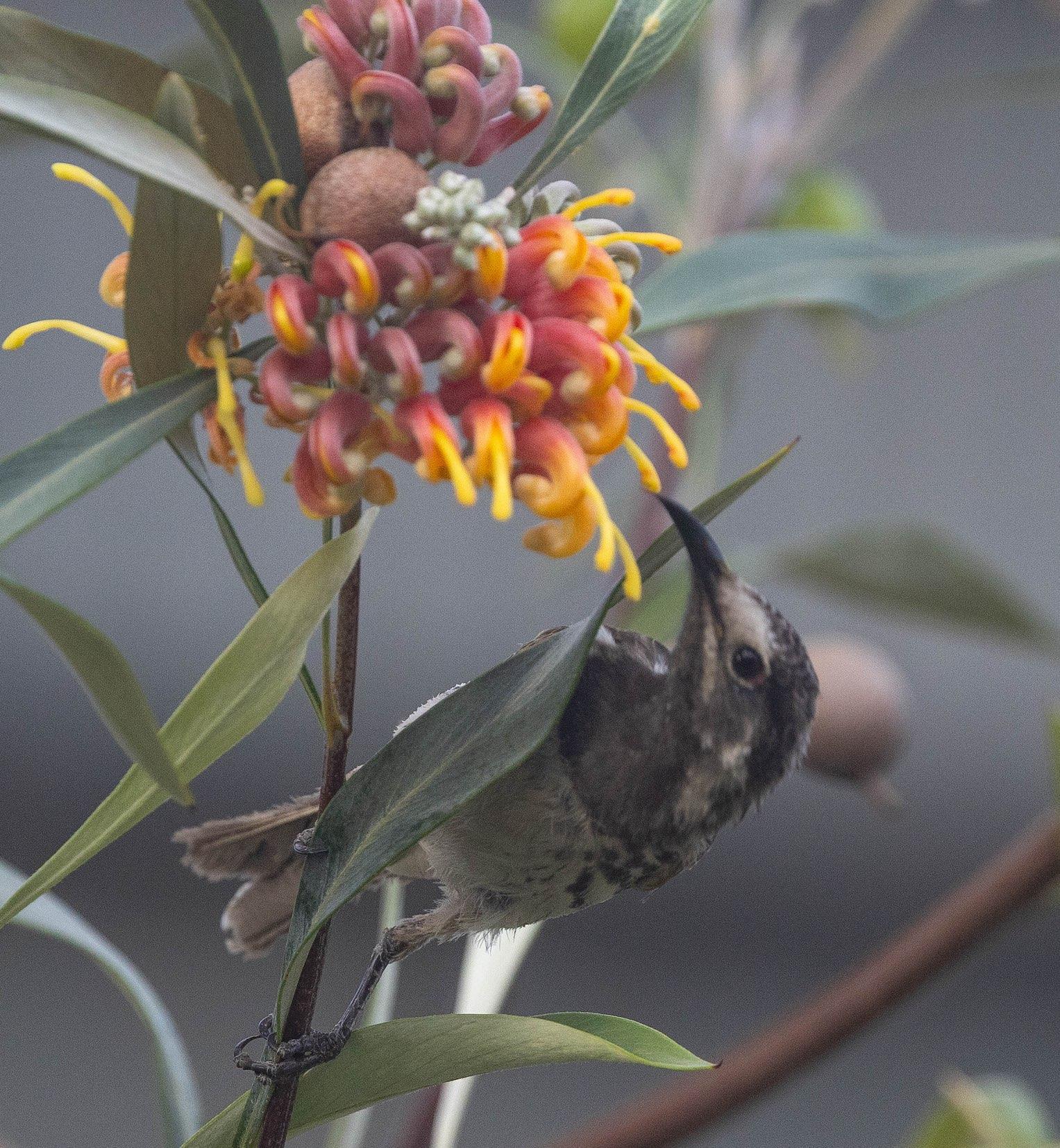
I photographed the bird and rushed over to consult my neighbour, ecologist Steve Morton. Appropriately, this was a white-fronted honeyeater (above), a confirmed nomad, common in the western desert regions, briefly taking our honeyeater tribe to seven species thanks to chance or maybe, just maybe, our Grevilleas from Balgo.
The distribution and bounty of nectar can lead to one species, usually white plumed or yellow throated miners, becoming hyper aggressive, seeking to monopolise the most productive plants and even driving out competition from the surrounding area.
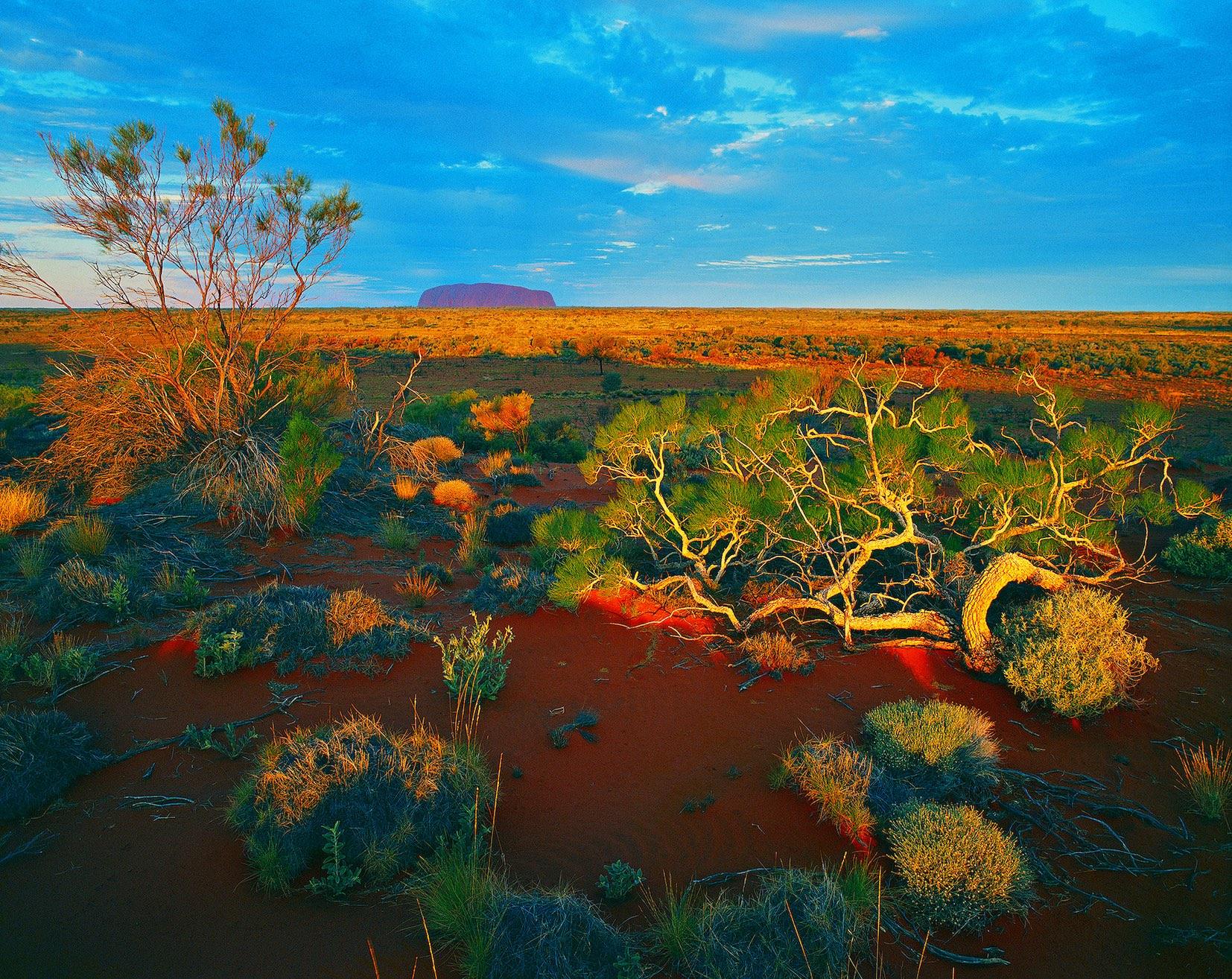
Diversity of Eremophillas underpins successful gardens in Alice Springs favouring the smaller honeyeaters, their beaks and tongues perfectly tailored to the narrow deep flowers.
At the newly established Yulara Resort I witnessed a dramatic imbalance when the hybrid, Grevillea Robin Gordon, a massive sugar producer became a dominant feature of gardens throughout the landscaped spine.
I’m describing ad hoc observations here, not some longitudinal scientific study and I’d like to know if the experiences of other gardeners concur.
In the early days of resort development I’d seen the before and after effects of landscape design. Initially the density of irrigated plants including impressive numbers of Eremophillas with small but prolific flowers had attracted multiple species into the resort walkways.
When the massive nectar production of the hybrid Grevilleas peaked, all the honeyeaters with the exception of domineering yellow throated miners largely vanished.
Thirty five years later the gardens of Yulara demonstrate what is possible with sufficient horticultural investment, ambition and skills.

Sources of nectar are more dispersed now although several clumps of Grevillea Robin Gordon are still monopolised by yellow throated miners (above). Shrubs with prolific small flowers sustain a high diversity of honey-eaters and greater equilibrium has been achieved.
Yulara has the space and ambition to express a rich botanical palette and their honeyeater "bullies" are happily anchored to fewer pockets of Grevillea hybrids.
At Hele Crescent we took care to spread the Grevillea refracta plantings around our gardens, with a few groups and more numerous single plants. The result has been brilliant and summer invertebrates, notably butterflies, bees and wasps join the honey-eaters, enlivening our gardens further.
Despite the careful dispersal of Grevilleas across the site and the continuing presence of our resident honeyeaters I must admit the yellow throated miners appear more assertive.
While there are no metal sculptures per se at Yulara, it’s impossible to overlook the immense sculptural power of trees and shrubs that provide a striking sense of place.
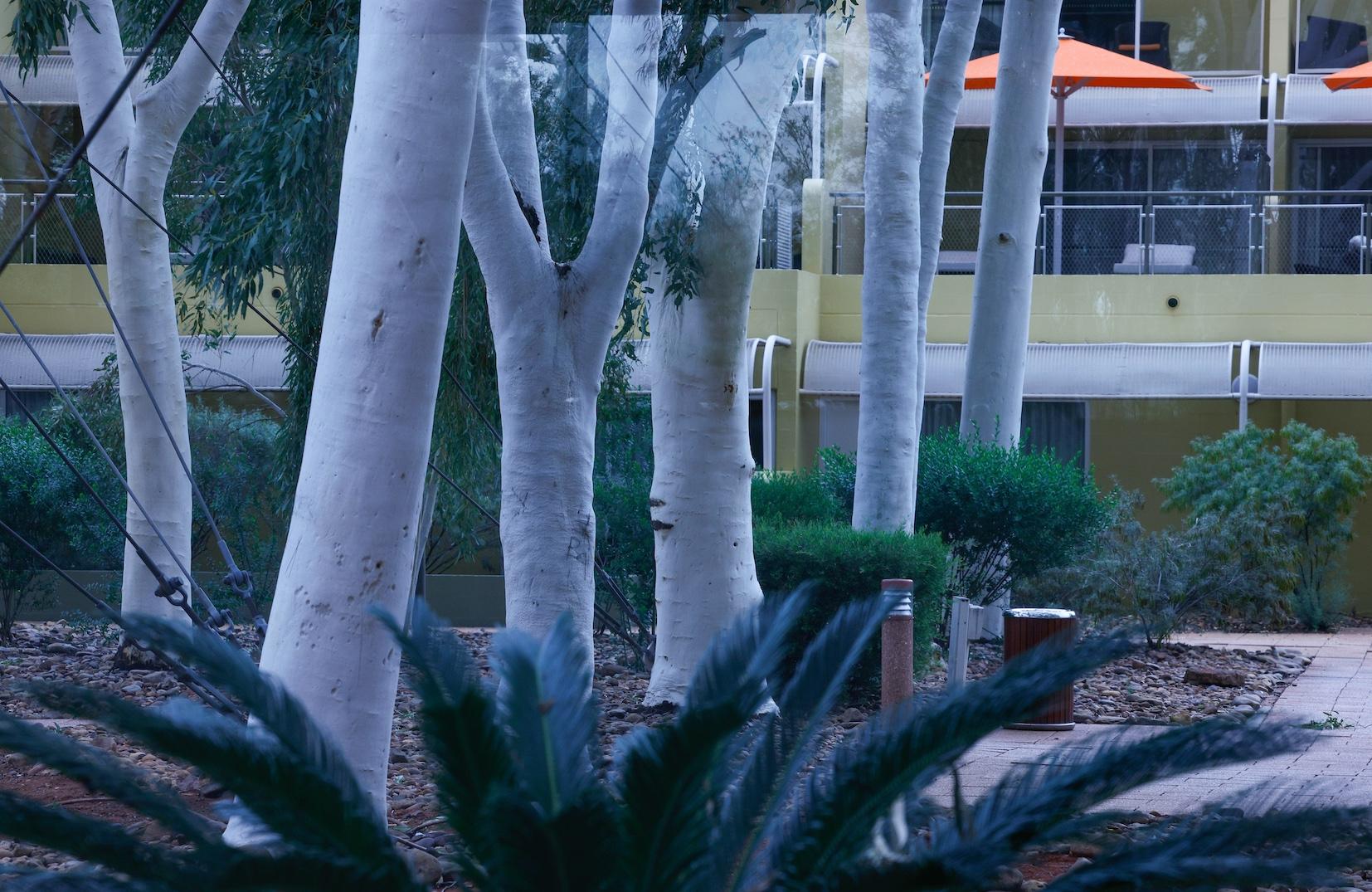
The climax groupings of ghost gums and cycads at the Desert Sails (at right) are especially admired. Alice Springs could certainly learn from the horticultural triumph and environmental respect that resonates at Yulara, doubtless influenced by the proximity of a premier national park at Uluru.
With visitors numbering between 250,000 to 400,000 a year, the generous central island that anchors the ring road is in excellent shape, by and large people remain on well-designed pathways and the delicate sandhill plants are thriving, surprisingly protected from careless footfall.
There are very few signs exhorting tourists to mind their manners yet the pristine base-line seems to have cast a spell over myriad nationalities and ages.
I believe the conspicuous care invested in horticulture helps to regulate human behaviour and cue respect. Beauty, diversity and the bounty of desert landscaping, has cleverly set the rules of engagement for visitors seeking immersion in nature.
The same could be said for the Alice Springs Desert Park. I doubt you will ever see anti-social motorbike riders doing a mono on footpaths in either location.
PHOTO at top: Brown honeyeater in Grevillea refracta. All photographs © MIKE GILLAM.
SOON: Wherever possible we should strive to enhance the cultural landscape that predates the omnipresent European streetscapes and celebrate the Mparntwe world view which makes Alice Springs so incredible.