


Repairing the balance sheet or digging the hole deeper?
COMMENT by RALPH FOLDS
"Strong primary industries, mostly mining and growing food, make for strong states,” says NT Treasurer Bill Yan. It sounds good. But there is a rather obvious question for Yan and the CLP Government: can the Territory be strong while drowning in debt?
The NT has extraordinary natural resources, yet is still Australia's most indebted jurisdiction per head and net debt is growing by well over $1 billion a year — more than $2m a day.
The actual 2026/27 increase sees debt rising by $1.2 billion in 2026/27 — equivalent to about $3.3m a day.
This cannot continue indefinitely. Eventually the services we rely on will have to be cut. Is the CLP Government actually repairing the balance sheet, or digging the hole deeper? Against that backdrop, the CLP’s economic vision deserves far more scrutiny than it has received.
Start with the long-promised Beetaloo natural gas bonanza. Yan promotes it as generating "$17 billion worth of economic activity" — but that figure bundles together royalties, jobs and business growth over 20 years, and very little of it will ever reach NT Treasury coffers.
Beetaloo gas may eventually become a useful source of royalties. But on reasonable assumptions, the Territory might receive somewhere around $150m to $200m in royalties over five years. Welcome money — but only about 1.5% to 2% of one year's NT government revenue.
Petroleum royalty is 10% of the estimated sales value of raw oil or gas.
[The author's calculations are available. Ask us.]
There's also the proposed "hyperscale" data centre development riding on the back of Beetaloo gas.
The Territory is betting a major part of its economic future on fossil-fuel infrastructure at precisely the moment governments and major corporations are under growing pressure to decarbonise.
Canberra has now vowed to use Federal legislation to override approvals of data centres that rely on non-green energy models.
Canberra’s opposition raises another problem for the CLP’s economic vision. Even if Beetaloo eventually produces substantial royalties for the NT, those royalties don't make the associated greenhouse emissions disappear.
Then there's Nolans, the Territory's mining flagship for the better part of two decades. Yan calls a 2029 start "soon"; 2030–31 is more realistic.
Arafura will pay royalties of roughly $11m in its first year, rising to around $21m and then $28m in the years after. Nolans will provide jobs, investment and economic activity, and those benefits shouldn't be dismissed — but the numbers need perspective.
The ramp up years are not stated but can be estimated at $25m to $26m a year for full-production numbers.
A project employing somewhere around 350 to 370 permanent workers, with an annual payroll perhaps in the $60m to $80m range, would generate around $4m a year in payroll tax. That's far from transformational for a government facing a fiscal hole measured in billions.
And there are mines in the making, such as White Devil, but nothing large on the near horizon — it typically takes about 10 years from discovery to production, so a booming commodity price today doesn't mean royalty cheques tomorrow.
Tourism is the one area where the government has a genuine story to tell. NT visitation was 17% higher in 2025 than a year earlier, reaching 1.2 million visitors. Visitor expenditure rose even more strongly, increasing 35% to $2.3 billion.
Real private-sector investment sits behind those numbers – Journey Beyond's acquisition of Voyages Indigenous Tourism Australia, investment in Darwin accommodation, and expansion of walking and cruise tourism.
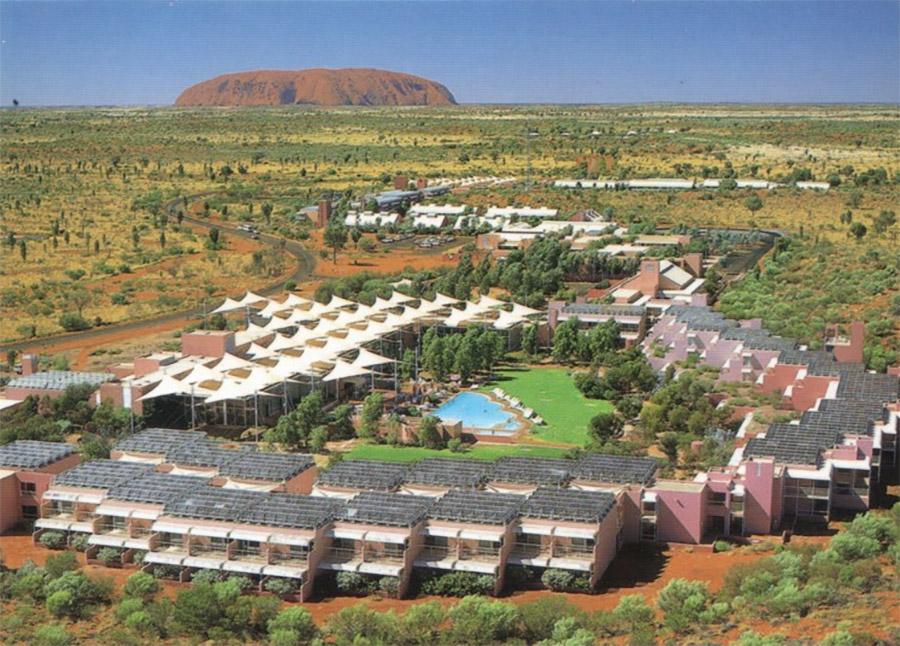
The American Journey Beyond, which runs the Ghan, since February owns the company operating the Ayers Rock Resort but not the land it stands on. That is is being transferred to Anangu Pitjantjatjara Yankunytjatjara (APY) Traditional Owners.
That's the kind of private-sector growth the Territory needs. But tourism, however welcome, will hardly dent a balance sheet deteriorating by hundreds of millions of dollars a year.
Yan also points to the Territory's unemployment figures, but the headline rate doesn't tell the whole story.
The employment base remains heavily dependent on government and community-services jobs, while the sectors the CLP identifies as central to its strategy are going backwards: Employment in mining and manufacturing has fallen 11.6% to 6,708 people. That is not an economy being transformed by a mining-led private-sector boom.
Budget repair also means stopping waste — and this is where the government's credibility really starts to unravel. A genuinely broke Territory should be scrutinising every major expenditure decision. Instead, Territorians have watched project after project raise serious questions.
The Darwin Ship Lift is the clearest example: The Treasurer's May 2026 budget put it at $850 million to build and $1.8 billion over its lifetime, with still no convincing evidence of a business model capable of generating a financial return to the Territory.
No customers are publicly locked in, and if the facility ever does turn a commercial profit, that profit won't flow to Territory taxpayers.
Similar questions surround the government's handling of the Fortune Agribusiness water licence. The Territory tried to give away access to an enormously valuable public resource. It then spent public money defending that decision right through to the High Court — and lost.
This was in part because it failed to properly explain and defend the licence to traditional owners.
A government trying to repair its balance sheet cannot afford to treat valuable public assets so casually, without demonstrating that the public interest is protected.
The NT doesn't have a resource problem. It has a fiscal management problem.
And perhaps the most troubling issue of all is that Territorians cannot properly judge this government's performance unless we can see how its decisions are actually made.
The 2025 Report on the Independence of Auditors-General ranked the NT Auditor-General last of any Australian jurisdiction for independence — behind also Papua New Guinea and Fiji. The NT Auditor General Jara Dean says he is not surprised.
The Centre for Public Integrity has criticised the CLP Government's continued refusal to strengthen his office's powers and resourcing.
A government presiding over Australia's worst fiscal position should be the most transparent government in the country. Right now, it is the least.
PHOTO: The Ayers Rock Resort management company has a new owner – a great Territory investment. Pity it's from overseas.