
Serious crime on the rise: Here is the proof
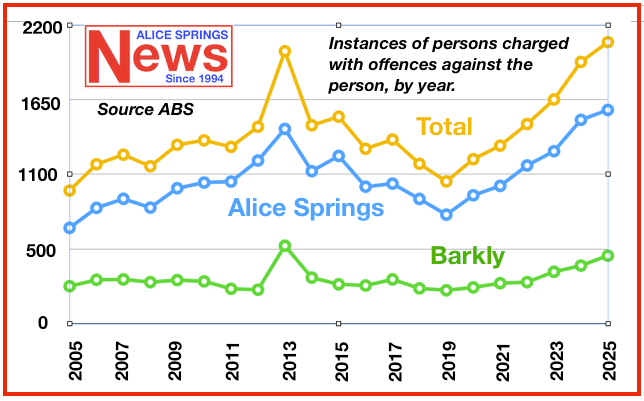
“Offences against the person” – assaults, for example – have doubled in Central Australia in the past 20 years.
In Alice Springs a steep increase in these offences took place between 2005 and 2012 during the Labor governments of Clare Martin and Paul Henderson, reaching a peak which was repeated at the end of last year.
Between 2013 and 2016 the CLP governments of Terry Mills and Adam Giles brought the offences half way down to where they were in 2005.
For a while that trend continued under Labor’s Michael Gunner but in 2019, sharp increases resumed and continued during the Fyles and Lawler Labor governments.
The CLP’s Lia Finocchiaro took over in 2024. The increase in offence numbers continued during 2025.
Last year The Alice finished with nearly 1650 incidents – 1000 more than two decades ago.
By comparison the increase over the 20 years in Barkly was almost flat although it also had a peak in 2013.
The numbers come from the Australian Bureau of Statistics and are titled “instances of persons charged with offences against the person, by year”.

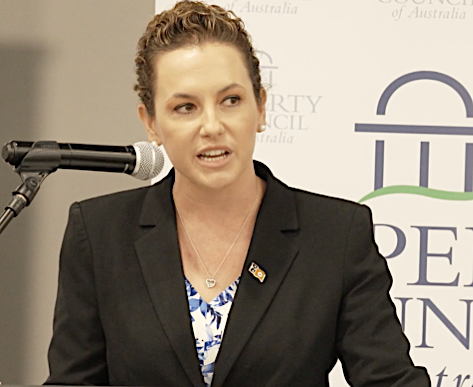
The dramatic increase occurred on the watch of these eight Chief Ministers (from left) Clare Martin (Labor) 2001-2007; Paul Henderson (Labor) 2007-2012; Terry Mills (CLP) 2012-0213; Adam Giles (CLP) 2013-2016; Michael Gunner (Labor) 2016-2022; Natasha Fyles (Labor) 2022-2023; Eva Lawler (Labor) 2023-2024 and Lia Finocchiaro (CLP) from 2024.
The Alice Springs News obtained the information through the NT Attorney-General’s Department.
A spokesperson said: "These figures represent instances of persons charged with offences against the person. They are not a count of offences committed, victims or unique alleged offenders, and should not be directly compared with NT Police crime statistics.
“Police statistics and court charge data measure different components and stages of the justice system."

3 comments
Rolf Gerritsen
If I were a CLP person, I could interpret the increased conviction rates as a sign that my government's policies are succeeding. More convictions may just represent a higher proportion of arrests per crime committed and may reflect the recent increase in police numbers.
Ralph Folds
There is an important qualification missing from this analysis. Alice Springs police are now considerably better equipped to detect and apprehend offenders than they were 20 years ago.
Drones, CCTV, specialist response teams and improved intelligence gathering have transformed their capacity to identify people who might previously have escaped detection.
The figures quoted are numbers of people charged, not simply a count of crimes committed. Consequently, an increase may reflect more offending, more effective policing, or a combination of both.
It is therefore questionable to attribute the fluctuations to whichever political party happened to be in government at the time.
Before drawing political conclusions, we need to know how much of the increase reflects actual growth in offending and how much reflects improved police detection and enforcement.
Better policing can produce worse-looking crime statistics. That possibility deserves serious consideration.
Frank Baarda
Sorry to be pedantic.
The title of this article should more accurately be "Reported serious crime on the rise".
As for "proof" the article has its own caveat.
"These figures represent instances of persons charged with offences against the person. They are not a count of offences committed, victims or unique alleged offenders, and should not be directly compared with NT Police crime statistics.
“Police statistics and court charge data measure different components and stages of the justice system."
Crime figures in the NT are highly politicised. Elections are fought and won or lost on the basis of "tough on crime" and a not far from the surface but not mentioned racism.
To qualify as "proof" these crime statistics should be examined with more context and nuance as Kieran Finnane did in her book 'Trouble – On Trial on Central Australia'.
ED: Hi Frank, we’re standing by our headline. Your quote about what the figures represent is part of our story. We are using ABS information about “offences against the person” gathered in a consistent manner over two decades.We are quoting the NT Attorney-General’s Department that the ABS figures “should not be directly compared with NT Police crime statistics. Police statistics and court charge data measure different components and stages of the justice system." We are resorting to ABS data precisely because there are no equivalent police statistics covering a 20 year time span. This is because the way police statistics are generated is changed from time to time, preventing apple-with-apple comparisons.
That creates nifty opportunities, based on short-time observations, to make the government look great. Our story is an authentic contribution to the current debate about crime decreasing.