


The Alice Big House: Should prisons be closed?
By ERWIN CHLANDA
As the world trembles in terror about losing control over AI, the Finocchiaro government has come up with an answer: Even the pinnacle of IT is powerless in the face of political spin.
We asked ChatGPT about the number of offenders against the person, year by year, in Central Australia since 2005.
“I can’t yet give you a defensible 2005-to-present year-by-year series from the sources I’ve been able to verify,” replied Chat that usually has the answer in a second or two.
“The NT’s current criminal-justice statistics system contains the relevant data, but the older regional offender series is not readily exposed in the indexed publications I found."
And: "I have searched the publicly indexed NT Government, Parliament and Central Australia publications, but I cannot find the historical table itself.
"The fact that the 2021 Central Australia publication says its regional figures came from 'special table[s]' extracted by the Department is a strong indication that at least some of these regional offender tables were produced on request rather than maintained as a public downloadable series."
At that point Chat gives up: "The next best route is an NT Government data request for the IJIS-derived table."
What the platform discovered was the result of the decades-long bi-partisan habit of tinkering with crime stats, making it impossible to compare apples with apples which gives the politicians the liberty of force-feeding the public facts that make them look good.
Neither Police Minister Finocchiaro, nor the police, nor Minister for Prisons Gerard Maley, the Deputy Chief Minister, agreed to be interviewed about the issues.
Meanwhile acts intended to cause injury (the violent crime rate) stands at 1068 per 100,000 in the NT, well over double the nation's 406 (ABS).
And in 2024-25 the NT had, per capita, nearly three times as many cops compared to the national figure, 767 full time equivalent operational police staff per 100,000 population, compared to 264 for the nation. Double the crime, triple the cops.
In Australia, and the USA, there is growing pressure to reduce the roles of police and prisons in crime control.
This includes extreme views that both should be abolished, in favour of an increased community involvement and an emphasis on prevention.
Groups in Australia include Sisters Inside, Change The Record, Just Reinvest, Australians for Native Title and Reconciliation (ANTAR), Jumbunna Institute, Australia's National Justice Reinvestment Program, Transforming Justice Australia and Smart Justice for Young People.
Ms Finocchiaro's answer is to recruit 300 more cops and build 1200 more prison "beds".
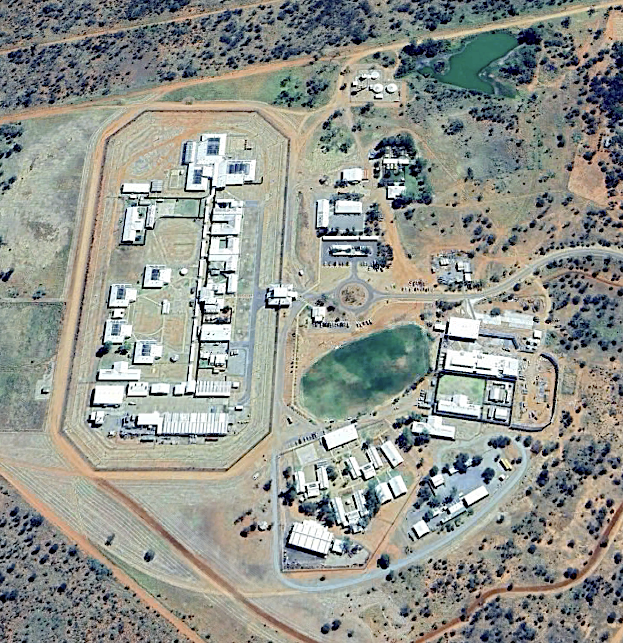
On August 31 there were 784 men in the Alice Springs Correctional Centre, known as the Big House. There are vocal activists saying that 488 of them shouldn’t be there.
Why? 363 of them were behind bars as remand prisoners, innocent people because they had not yet been proven guilty and some maybe never will be.
Of the 421 sentenced prisoners 296 had been found guilty for offences against the person. 125 had not. Clearly the NT has no better way of protecting our community than taking away someone’s freedom for a trifling act like not paying a fine or even stealing a car.
All up, including women, there were 828 people in the Alice Springs Correctional Centre on August 31, 2026.
The question is: Does the relentless chain work – police, court, prison, police, court, prison and so on?
In America Doug Henwood's Behind the News podcast this month had as its guest Alex Vitale, speaking about his book Life After Cops and Jails, advocating that jails should be for "an extremely small number of people".
He says the ultimate objective should be addressing systems of exploitation and reducing inequality, and non police strategies that are community based, lifting people up.
In very poor areas people should be hired from the community who have a history of involvement in the community, in street life.
They may sometimes have done harmful things, but are known in the community, are part of a network.
This should be coupled with crisis stabilisation services. They are likely to know if a neighbour is in trouble.
Prior to the Parkland school shooting police, having become aware of "a pattern of disciplinary issues and unnerving behaviour," knocked on the door of the young shooter. He said no, I won't do it. Result: 17 dead, 17 injured.
The focus should be on unhoused people with unaddressed past trauma, says Mr Vitale.
They should develop networks, be the eyes and ears, intervene directly. They should be people known in the neighbourhood, trusted, have respect of people, be known as reliable.
Police intervention in trouble can lead to an escalation. Calling the police in response to violence should not be the only solution.
Tailored interventions should be followed up with restorative practices, says Mr Vitale in Henwood's podcast.
None of these notions appear in the syllabus of the 30-week, full-time paid recruit constable course conducted by the NT Police.
The 12 main subjects include learning the laws relevant to policing in the Northern Territory, operational standards, defensive and officer-safety skills, firearms training, operational driving skills, fitness, information systems, cultural awareness, search and rescue and domestic violence response.

Sisters Inside CEO Debbie Kilroy OAM (pictured), who was first criminalised at the age of 13 and spent over two decades in and out of women’s and children’s prisons, including for trafficking drugs, is calling for no less than "total annihilation" of prisons and consequently the police.
"I stand against softer options, against reform creeping in as the compromise," she said in an address to the College of Business, Law and Governance of the James Cook University in Brisbane.
"Overlapping interests of the state and industry that employ policing, surveillance, imprisonment and punishment as a means of control of a population are furthering the colonial project.
"At the core of this struggle is punishment … racial capitalism. I want to burn it all down. To the ground, absolutely all of it," she says, now a lawyer.
The "prison industrial complex" is creating "needless places of suffering and violence ... stealing from all of us".
Ms Kilroy is calling for a freedom fight.